
Sunday, June 9, 2013

Wednesday, June 5, 2013
June Broom

Sweeping up this month's regional musical debris into our aural dustpan...
...okay, we're not big on analogies today:
June 6 Josh Nelson Trio w/ Anthony Wilson @ Vitello's....June 6-9 Ojai Music Festival @ The Libbey Bowl....June 7 The Kandinsky Effect @ The Blue Whale....June 7-8 Azar Lawrence Quintet @ The RG Club....June 7-8 Harry Partch: Eroica Dances @ REDCAT....June 8 Jeff Richman Group @ Alva's Showroom....June 9 DEVO w/ GZA/The Genius @ Natural History Museum....June 11 Jacques Lesure Quartet @ The Blue Whale....June 12 Vinny Golia Sextet & Bad Luck @ Grand Star Jazz....June 12 Julian Coryell @ Vitello's....June 13-14 Anthony Wilson's The Curators @ The Blue Whale....June 14 Billy Childs Quartet @ LACMA....June 14-15 Azar Lawrence Quintet @ The RG Club....June 14-15 Brian Auger's Oblivion Express @ Baked Potato....June 15 Robert DeLong @ The Getty....June 15 Robert Glasper Experiment @ Playboy Jazz Festival....June 15 Charged Particles @ Alva's Showroom....June 15 Bennie Maupin Group @ The Blue Whale....June 15 Stones Throw Documentary Premiere Party @ ExchangeLA....June 15 MicroFest Presents: Aron Kallay: I (Tune) NY @ Villa Aurora....June 16 Tom Ranier Group @ Vibrato....June 16 The Jazz Leaders @ Levitt Pavilion....June 17 Barry Zweig Trio w/ Katie Thiroux & Matt Witek @ Vitello's....June 20 Todd Sickafoose + Tiny Resistors @ The Blue Whale....June 21 Ariel Pink's Haunted Graffiti @ First Unitarian Church....June 22 OHM @ The Baked Potato....June 23 A Night in Bronzeville with Miguel Atwood Ferguson Ensemble @ The Blue Whale....June 23 Corey Marc Fogel, Rick Potts & Michael-Pierre Vlatkovich @ Sherman Oaks Guitar Center....June 24 Complete Communion: A Musical Tribute to Don Cherry w/ David Ornette Cherry & Organic Roots @ ALOUD Festival....June 24-25 Gerald Clayton w/ Ambrose Akinmusire @ The Blue Whale....June 26 Tom McNalley Trio & Cardoo @ Grand Star Jazz....June 27 Death at Amoeba Music....June 27 Colin Stetson @ Bootleg Theater....June 27 Steuart Liebig & Joe Berardi @ Battery Books & Music....June 28 Michael White Quintet @ Grand Performances....June 28-30 Kenny Burrell Quintet @ Catalina's....June 29 Death @ the Silent Movie Theatre....June 29 The Roots @ Club Nokia....June 30 Yuko Mabuchi @ Levitt Pavilion....June 30 John Tejada @ California Plaza....June 30 Charles Wright & the Watts 103rd Street Band @ Amoeba Music
Tuesday, June 4, 2013
La Storia Completa E Totale Di Musica (Pt. 4)

Medici House Band
The Beast has an ongoing series we haven't done for awhile called The Complete & Utter History of Music on YouTube, which was meant to educate ourselves as well as entertain y'all. We just returned from a Spring hiatus to Italy and would like to add on a post on the places we visited that fit into the overall narrative. Especially since we found ourselves in two cities known for their museums tracing the origins of our modern instruments: Bologna, called Italy's "city of Music" and Florence, where the piano was invented. Score!
Bologna is dominated by the local university and like Austin, TX or Chapel Hill, NC (or even Xalapa, Mexico) still has a vibrant music scene. Only Bologna's music scene goes back about, oh, a couple thousand years. Always a bit of an artsy, proudly Leftie city -- we arrived in the midst of the annual May Day Festival in the main Piazza Magiorre, where a band was rolling through an Italian version of "The Ghost of Tom Joad" before an enormous banner proclaiming Lavoro, Sviluppo, Legalità ("Work, Development, Legality") and a lot of young white hipsters bearing wraparound Italian sciarpas and t-shirts proclaiming "Basta!" ("Enough!" -- some sort of local anarchist cry). They were the inheritors of a city who had seen many great musicians -- Ottorino Resppighi, Gioacchino Rossini (who debuted at age 13 in 1805 at the city's Teatro del Cortso), Gaetano Donizetti, Padre Giovanni Battista Martini and even Wolfgang Amadeus Mozart -- who have either lived, studied or performed in Bologna. The Academica Filarmonica, founded in 1666, included Rossini, Wagner, Verdi, Puccini, Liszt and Brahms as members.
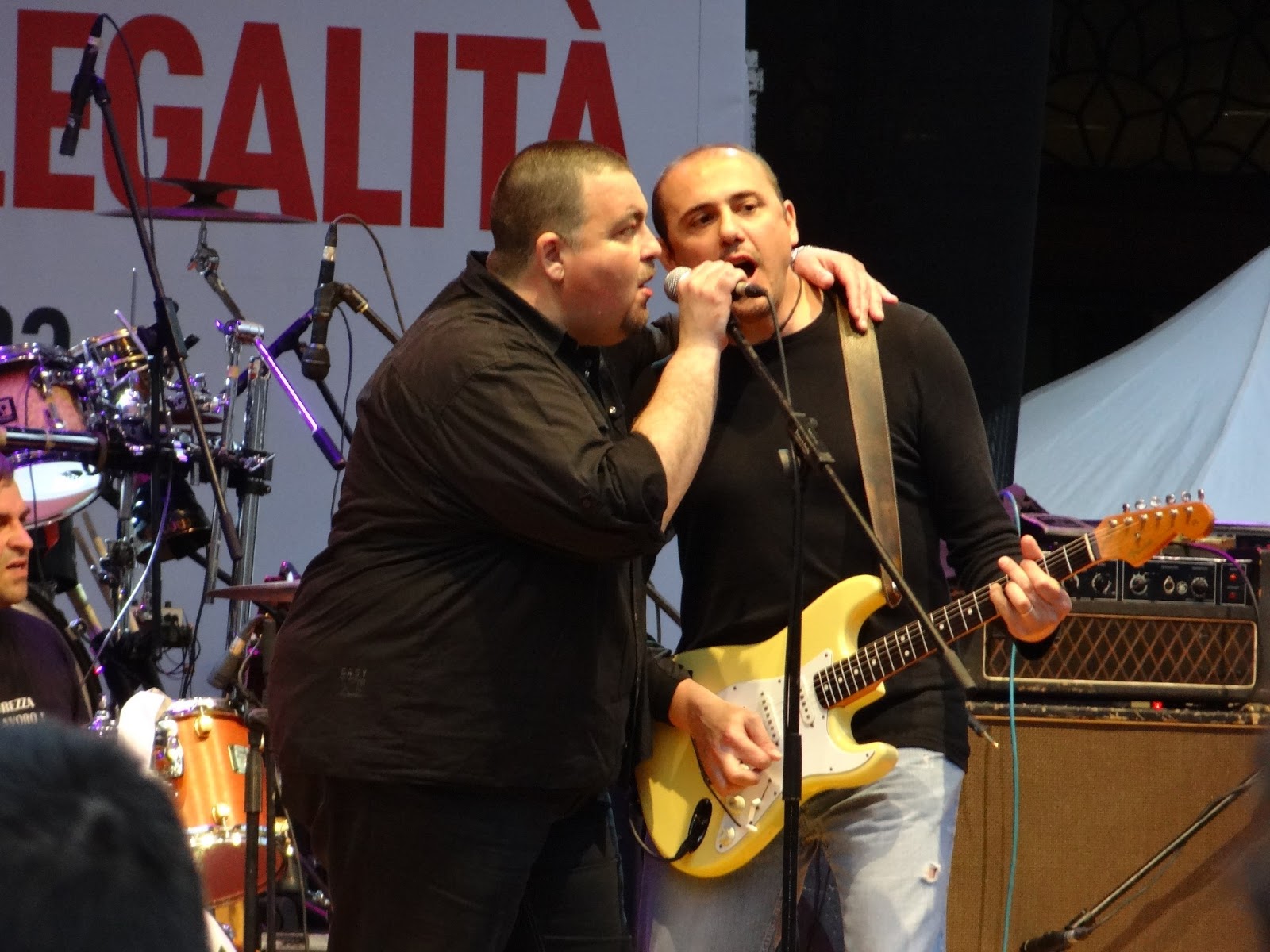
"...alla ricerca del fantasma di Tom Joad"
We caught a snootful of Northern Italian Hip-Hop at Arteria, a small club right by the University with a dizzyingly quick lineup of bands like BoomBap Haze, Ribbores, E-Green and Brain. (Note: Italian hip-hoppers don't say "yo-yo-yo" but "ya-ya-ya" and it's not at all annoying; they also give shout outs to their own band names at least every other line, almost double that of American rappers). We stood sipping on a Bierra Moretti and watched this cavalcade from a giant cloud of marijuana smoke in the basement of some ancient crumbling dance club. Just two blocks away on Strada Maggiore was the International Music Museum and Library, where the Beast and Mrs. Beast had paid a visit to just a few hours before. The place contains about six centuries of well-preserved musical history in the stunningly restored 18th-century Palazzo Sanguinetti; the entrance is through a grand-domed staircase where hundreds of tiny stars hang from thin wires and give the impression they are floating in midair:

Of course, this was only prelude to the goodies inside. There;s the Harmonice musices odhecaton A, the first musical instruction book printed with movable type by Ottaviano Petrucci in 1501, an anthology of French-Italian chansons that made printed music available to the masses, where previously it had been the province of vanity luxury items of the very rich. (Essentially, the Rosetta stone to all those Mel Bay books we grew up with.) There's Rossini's autographed original score to Il Barbierie di Siviglia. There's the entrance examination from to the Accademia Filarmonica by a young Wolfgang Amadeus Mozart that he, under the aegis of his mentor Padre Giovanni Battista Martini, submitted on October 9, 1770; apparently, the young prodigy failed to understand musical counterpoint and Martini, who just happened to be one of counterpoints pioneering theorists, had to pencil-whip it into shape to his student could pass. (A few months later, the 14-year-old Mozart, who had already dropped out of the Accademica, debuted his opera Mitridate in Milan.)

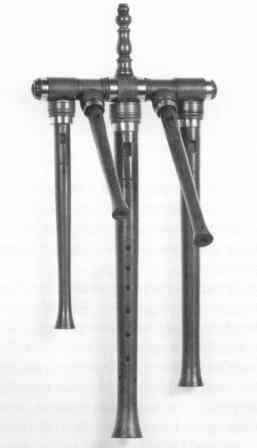
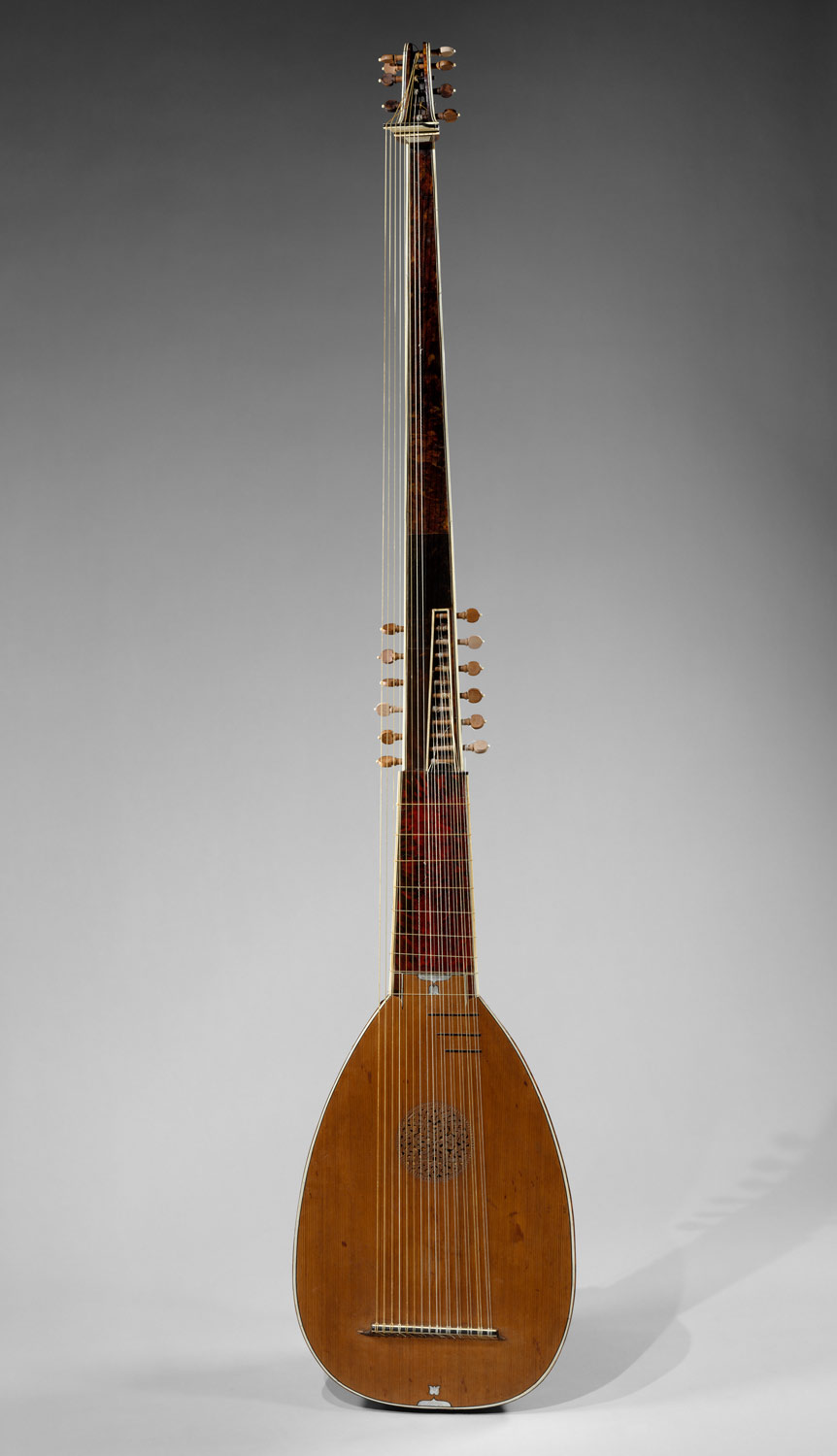
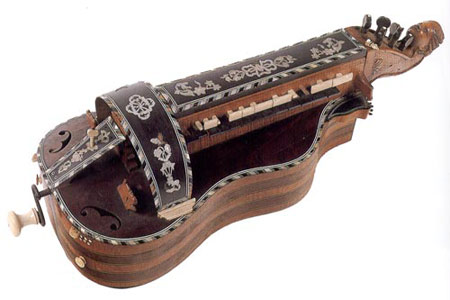
But the best part was its collection of musical instruments, including an amazing pair of chromatic double-harps [pictured above] -- one carved in maple; the other sculpted from pine into the figure of a female -- that were the antecedent to the piano. There was a diverse assortment of five-piped flutes (Armonia di flauti), the sordellina, which is a set of bellows with numerous boxwood pipes that resemble lobster claws, and stringed instruments like the Archlute, a pineapple-shaped soundbox with an impossibly long neck and a wonderfully complex interweb of single and double strings. There were such truly rare and esoteric inclusions as the Heckelphone (sort of a giant oboe), an omnitonum (monochord) harpsichord created in 1606 by Vita Trasuntino, a series of pochettes (small violins used by dancers), and of course, that Sting/Arcade Fire-revived/Donovan name-checked hipster instrument the coppia di ghironde ("hurdy-gurdy"), popular with court dancers and street beggars alike in the 16th and 17th centuries that looks like a large pepper grinder and makes music much the same way, by rotating a rosined wheel inside a hollow wooden box.

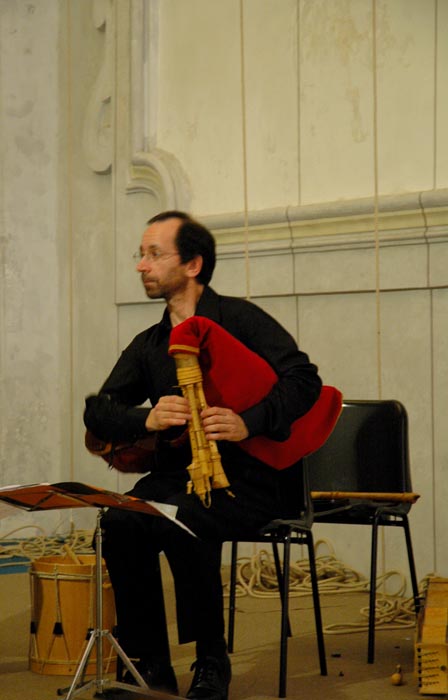
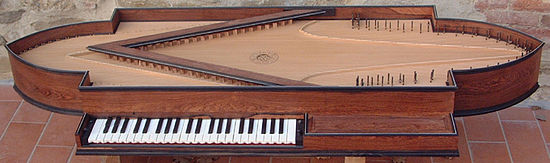
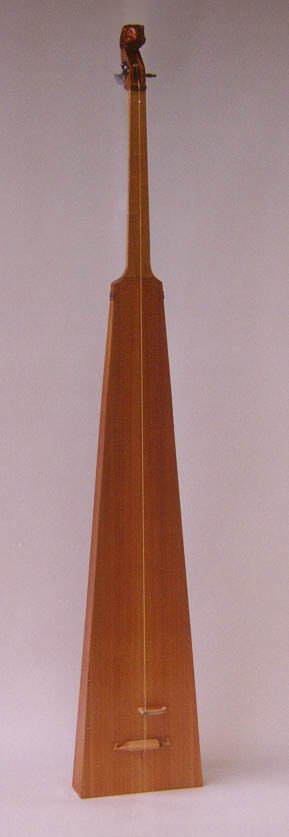
We continued our musical-instrument tourism in Florence at the Galleria dell'Accademia, which holds a mouth-watering array of swag from the powerful Medici and Lorraine clans. Much of the collection comes from Grand Prince Ferdinando de' Medici (1663-1713), who was more of a music and arts lover than his politically charged family. Among the treasures was the salterio, a sort of flat box engineered from different types of marble that contains twenty strings to be plucked or strummed (the antecedent to the hammer dulcimer and the autoharp); a spinette ovale, built in 1690 by master Florencian craftsman Bartolomeo Cristofori (1655-1732) out of rosewood and cypress, a rectangular case with Gothic-arch sides containing symmetrical strings with a small ivory keyboard (the antecedent, we surmise, to the Casio portable keyboard); a pianoforte vertical [pictured above] that was basically a grand piano with the entire case folded straight up in the air in a spectacular "giraffe" shape; a serpentone, which is a bass horn constructed out of leather and chestnut wood in the form of a long snake; a corno di bassetto that looked like a clarinet with hinges; the tromba marina, which is sort of like a piece of clock-shaped furniture with a single bass string (shades of the diddley-bow) that when plucked or bowed apparently sounds like a trumpet (??); a splendid pair of hurdy-gurdies carved out of mahogany and overlaid with mother-of-pearl; and our personal favorite, a strange little character called the chitarra a pianoforte [pictured below] which is like a teardrop-shaped lute with a tiny little five-key chromatic keyboard mounted right above the bridge; apparently, this was constructed by a London guitar maker who was asked to create an instrument "suitable of girls of good families" that would safeguard their soft fingertips.

Oh, and there were also a bunch of churches, museums and ancient ruins and stuff.
Thursday, May 30, 2013

Wednesday, May 29, 2013
"Drugs and Loneliness -- Some Jazz"

Joseph Albany
Last night, the Beast had dinner with some friends who related to us that filming of a new L.A.-based jazz biopic is now actually in production as we speak (filming is currently underway at The Dresden Room). From the outset, Low Down might seem like a strange project. It's based on the dark memoir of Amy Albany about her life with her father, the troubled bop pianist Joe Albany.
Albany is not very well-known outside of jazz freaks and even there he's sort of a murky figure due to his persistent jail and drug problems during the 1960s and 1970s. But he was at the apex of bebop in the 1940s, when he backed Charlie Parker, Miles Davis, Benny Carter, Dexter Gordon, Roy Haynes, Howard McGhee, Lester Young and Charles Mingus. He was part of the enviable, rotating house band at Little Tokyo's Club Finale that included Hampton Hawes, Russ Freeman, Addison Farmer, Red Callender and Roy Porter. Because of his demons, Albany released only one album between 1957 and 1971, The Right Combination, but it is a corker of a record with equally troubled saxophonist Warne Marsh (about whom we also heard a documentary is in the works) and bassist Bob Whitlock.
Actor Mark Ruffalo was originally reported to be playing Albany, but turns out he's producing the film; no matter, the Oscar-nominated actor John Hawkes is playing Albany, so we can all sleep well at night that the role is in god hands. (Also on hand are some interesting casting choices, including Peter Dinklage, Flea and the luminous Elle Fanning as Amy Albany.) Besides, this frees up Ruffalo to appear later at the lead in some future biopic of Art Pepper. Don't laugh, he could pull it off.
We hope the new film will be an honest assessment but won't necessarily be, as one reviewer described Albany's memoir, "drugs and loneliness" wit "some jazz." In the meantime, there's a one-hour documentary Joe Albany: A Jazz Life that's available on YouTube to tide us over:
Wednesday, May 22, 2013
Bloggie Nights

Hi, we're back from vay-cay to Italy (which we will be posting about soon) and looks like we missed quite a lot of good stuff. Here's a smattering:
(New York Times)
(Salon)
WATCH: Drummer Matt Wilson's Amazing Speech
at the Jazz Education Network Conference
(YouTube)
Sound Check: Thundercat
(Soul Train)
LISTEN: Remembering Ray Manzarek
(NPR)
(Flavorwire)
(Huffington Post)
(Pitchfork Media)
On Being And Unbeing A Singer
(The Rumpus)
LISTEN: State of the L.A. Jazz Scene, Pt. 1
(Break the Mold)
The Day Punk Died Again
(The New Yorker)
The Source Family: Transform Our Culture Now!
(L.A. Record)
"I'm A Walking Bordello!": Q&A with Charlemagne Palestine
(The Quietus)
(The Wire)
(The Blue Moment)
(Chicago Reader)
(Free Jazz)
(Slate)
(The Revivalist)
(Pitchfork Media)
(New York Times)
(Rolling Stone)
(ExBerliner)
(Stereogum)
(Metal Underground)
(L.A. Weekly)
(NuVoid)
(Salon)
(Brooklyn Vegan)
(New York Times)
Charles Ives: Caught Between Two Caricatures
(PostClassic)
Charles Ives: Caught Between Two Caricatures
(PostClassic)
(Rolling Stone)
Delmark Records Turns 60
(Jazz Beyond Jazz)
Ojai Music Fest Launches Online University
(Sequenza21/)
What Classical Music Can Learn from Cats
(On An Overgrown Path)
Delmark Records Turns 60
(Jazz Beyond Jazz)
Ojai Music Fest Launches Online University
(Sequenza21/)
What Classical Music Can Learn from Cats
(On An Overgrown Path)
Monday, May 20, 2013





Subscribe to:
Posts (Atom)