Showing posts with label R.E.M.. Show all posts

Tuesday, November 15, 2011

THIS IS NOT A BIO: An Alternative History of R.E.M. (3 of 3)


[Go here to read Part 2]

The announcement of Bill Berry's departure really shouldn’t have come as a big surprise. His onstage brain aneurysm in 1995 was a clarifying moment for the drummer. “I'm still young enough that I can do something else,” he told MTV host Chris Connelly. “I've been pounding the tubs since I was nine years old ... I'm at a point in my life where some of my priorities have shifted.” True to their “all-four-one” ethic forged in their decade of obscurity, the other three members supported Berry. "I think it's a very courageous move for Bill to make," Michael Stipe told the Associated Press. "We're backing him in his decision, as sad as it is. It's a positive, because he'll be a lot happier out of the band, and we'll be able to continue without him with his blessing."

Other statements the band made to the press around this time had a similar robotic “press release/hyper-positive/everything’s fine” feeling to them. They were meant to send Bill off with no visible stress. However – to borrow a phrase from VH1 – “behind the scenes, things had grown tense.”

Jumping right into a new studio in San Francisco with a new producer, the threesome set themselves a grueling recording schedule. Unwise perhaps, as Stipe would later admit, “I completely shut down during the making of that record. I had the mother of all writer’s block, just because the band was falling apart.” It didn’t help that director Milos Forman approached the band to compose the score for his upcoming biopic on the comedian Andy Kaufman. Not one but two recording projects contributed to such tension that the band decided to take an extended hiatus from recording until the Summer of 1998, where they appeared at the Tibetan Freedom Concert. The anticipation was high for the live debut of the “new” R.E.M. and the band confused many by starting the set with an almost formless, electronica-flavored new song with Stipe donning a Tibetan monk robe. They were augmented by drummer Joey Waronker and keyboardist Scott McCaughey, which sparked speculation that the onetime drummer for Beck might inherit Berry’s drum seat.


They were wrong: R.E.M. decided to charge ahead as a trio and made the interesting decision to record songs for the new album with a series of drum machines and session drummers. It seemed to be yet another Viking-funeral choice for a million-selling band who could have written its own ticket. But instead of going back to the center, R.E.M. got even weirder. In an NPR interview around the time, Stipe and Buck revealed that the band was making an “electronic” album with a twist: they would only used old and outmoded analog keyboards, not “state of the art” equipment, in order to capture, as Buck explained “a sort of lo-fi approximation of technological decay.” This was an aesthetic being championed by indie bands like California’s Grandaddy and Virginia’s Sparklehorse. It resulted in what many have called “R.EM.’s bravest hour.”


Released nearly a year to the day of Bill Berry’s departure, Up at first seems to confront ears with songs that, according to one critic on AllMusic, “are easy to admire but hard to love.” There is much to admire: the menacing “Airportman,” the ominous, synth-washed “Lotus”; Stipe’s poignant lyrics and vocals on the soaring “Daysleeper” and the melancholy "Sad Professor"; Mike Mills’ Brian Wilson pastiche “At My Most Beautiful.” The record drew comparisons to Radiohead’s OK Computer (primarily because Radiohead engineer Nigel Godrich was on it), which would prove ironic, as Radiohead’s Thom Yorke would later admit that Up was an influence on the band’s classic Kid A. The U.K. press seemed to “get” Up in a way that U.S. critics didn’t: Q magazine gave the record 4 out of 5 stars; “Dean of Amnerican rock critics” Robert Christgau gave it a simple frowny face with no review whatsoever.


Perhaps in reaction to what it perceived as a disastrously anit-commercial record, Warner Bros. sent the band on a punishing schedule of promotional interviews and performances. Then it was off on a 6-month European tour immediately topped off by two more months of shows in the U.S. At the end of the mostly well-recieved tour, R.E.M. sat down to put the finishing touches on the soundtrack to the still-untitled Andy Kaufman biopic. Needless to say, the instrumental music was prosaic by the band’s standards, but R.E.M. composed two “official” new songs. One was “The Great Beyond,” and the less said about it the better. The other was something Stipe had been kicking around since his Athens days, when he heard the news of Kaufman’s death in 1984. That song that would eventally reach full flower as “Man on the Moon,” one of the band’s most memorable tunes because it had what the last two R.E.M. albums didn’t: A sense of humor. It also gave the Kaufman film a memorable title.


Of course, that didn’t help for Warner Brothers. After three albums – two with diminishing returns – rumors began circulating on the internet that the label was going to drop R.E.M. from its roster. (The rumor was started by a group of hacked emails from a Warner Music exec just before the release of Man on the Moon.) Apparently, the band heard the rumors and decided they were credible enough to try a bit of self-sabotage: They decided to break up before they were dropped from the label.

Naturally, Warner denied the rumors and then preceded to lawyer up agains the band’s rebellion, citing “breach of contract” despite the fact that the secret emails appeared to be legitimate. What began was a long dark legal winter for R.E.M. and its lawyers; strange, because R.E.M. as a band didn’t exist anymore. The label was essentially suing them in order to keep them together so they could drop them at a later date.

The blogpshere, of course, went wild. Many compared it to a similar situation experienced by the indie rock band Wilco, whose new album Yankee Hotel Foxtrot was rejected by Reprise Records, which (surprise!) was also owned by the Warner Music Group. “It’s obvious that the death of the record industry will not come solely from file-sharing but from the cluenessness and small-mindedness of its own executive pool. ” wrote the strident music blog Cream Cheese Driveway Death. “Once upon a time, ‘overpaid’ apparently meant 'omnipotent.’ No more.”

For the entire year of 2000, R.E.M. as a group existed only on the pages of depositions, and testimonies. “R.E.M. Is Dead!” became not a lament in graffiti or on homemade t-shirts but a clarion call for victory over corporate cluelessness. “Honestly, I really don’t know what all the fuss is about,” Mike Stipe told Billboard magazine with a sort of psychic wink. “We decided to break up before they decided to drop us, and now they want us to stay together because they’re mad that we beat them to the punch? Hello, operator?” Mike Mills added: “Just imagine how much material we’ve got for our next ten or twelve albiums. Solo albums, I mean. Like what KISS did.” The only appearance they made as a band that year was an unannounced gig at the Land Aid Festival on the front steps of the Clarke Country couthourse in Athens, performing (under the fake name “Dumbphuck”) a new song “I’ve Been High” to the delight of the mostly high crowd. The band even recorded and released two new tunes “Hastings & Main” and “Take Seven” for its annual Christmas club single under the pseudonym “Wuxtryvista Social Club.”


2001 saw the second year the band was hamstrung by a cornucopia of lawsuits and counterlawsuits. But they had already recorded and put the finishing touches on Michael Stipe’s first “solo album,” which was made available on the website www.michaelstipeisnotinaband.com on May 15. (Mills and Buck appeared as sidemen under the names “Ovis Queerhammer” and “Dr. Orlando Valenzola, M.D.”) Reveal was a buoyant, mutedly psychedelic pop cycle about transcendence and release (“The Lifting,” “I've Been High”, “Disappear”) whose shimmering – if occasionally languid and dour – 80s-era textures hid darker currents. In fact, Reveal was an appropriate title for Stipe’s first solo outing. Since 1994, rumors abounded about his sexual orientation, mainly because the singer refused to discuss the topic in interviews. But in January, five months before Reveal was released, Stipe gave an interview with Time magazine where he called himself a "queer artist" and “revealed” that he had been in a relationship with "an amazing man" for the last three years.

Meanwhile, the other members of R.E.M. kept busy. Buck and Mills managed to coax their old bandmate Bill Berry to record a casual, one-off session of mostly blues covers with cranky L.A. songwriter Warren Zevon (later released under the title Hindu Love Gods after Zevon’s untimely death in 2003). Mike Mills joined guitarist Tom Morello, songwriter Steve Earle and agit-folk singer Billy Bragg on the anti-Bush “Tell Us the Truth" tour and briefly became a guest announcer for the Atlanta Braves. Besides a fruitful series of musical collaborations with Ken Stringfellow and Scott McCaughey, Peter Buck launched a grassroots, tounge-in-cheek campaign to become the governor of Georgia, even recording a mock web commercial with Will Ferrell as George W. Bush and Jack Black as the Ghost of Richard Nixon.


The three members of R.E.M. had actually recorded a 9/11-inspired song “Bad Day,” released as a digital single in 2003 under Stipe’s solo moniker with the others again using nom-de-plumes. Early into the fourth year of R.E.M’s legal troubles and self-imposed recording ban, Stipe reconnected with Mike Mills and the two provided the majority of the musical beds of Stipe’s second solo album. Unfortunately, it would never be released. Similar to the imbroglios surrounding Prince’s Black Album and Dave Matthews’ Lillywhite Sessions, Stipe opted not to release the album because it “kinda sorta sucked.” (The record has popped up in bootleg form under the title Around the Sun.) When he heard it, Buck, in one of his more unguarded moments, told an Atlanta newspaper that he thought the record "just wasn't really listenable, because it sounds like what it is, a bunch of people that are so bored with the material that they can't stand it anymore." Stipe drowned his disappointment in political solidarity by joining Bruce Springsteen, Bright Eyes, John Fogerty and Neil Young for six dates of the 37-date Vote For Change tour that Fall.


Just before Chrismas 2004, R.E.M.’s half-decade tangle of lawsuits with Warner Music Group was finally untangled and settled discreetly out of court. Mysteriously, single CDs started popping up in Athens records stores with no credits on them. It was the foursome’s own private Christmas present to it’s hometown. Later dubbed by fans “R.E.M. Unbound: The Lawsuit CD” it featured a duo of songs meant as a kiss off to Warners: “I Wanted to Be Wrong” (“I told you I wanted to be wrong / But everyone is humming a song”), which was salvaged from Stipe's aborted solo sessions, and a surpise resuscitation of one of the first songs they wrote back in the early 1980s, “All the Right Friends,” which had the great kiss off line now so apopos to the band’s experience: “I've been walking alone now for a long long time / I don't wanna hang out now with the friends who just aren't mine.”

Of course the songs rapidly appeared online, and the R.E.M. is Back buzz began. Perversely, in October 2005, the full lineup including Bill Berry reunited at….a the wedding reception for their equipment manager at an Athens bowling alley. The foursome repeated this feat in September 2006, playing a two-song set for a benefit at the 40 Watt Club in Athens. That same month, R.E.M. was inducted in the Georgia Music Hall of Fame. The following year, R.E.M. roared back to life with a live album taken from the 2005 Point Dublin shows meant, in Buck’s words, “to remind our fans that we existed.” Strangely, there was a lot of material from Stipe’s unreleased second solo album, here given full flower in a live setting: the plaintive “Boy in the Well” and the metronomic “Electron Blue” became slow-building anthems; "Leaving New York" and “Final Straw” were quietly powerful mediations on post-9/11 America and the horrors of the Iraq War.


2008 dawned with the first new R.E.M. album in ten years, and the reunited foursome (Bill Berry announced he would be returning to the fold for one more album) with an unusually aggressive new record, fittingly called Accelerate (released on their new imprint It Crawled from the South Records), helmed by Irish producer Garret “Jacknife” lee (The Hives, Bloc Parrty, U2), who kept the recording schedule – not to mention Stipe’s lyrics and the band’s sound – tight, the record abounds in the joy of revivified creativity. That Spring, the band recorded an hour-long set for the TV show Austin City Limits and brought the new songs to ferocious life: the rocking “Living Well Is the Best Revenge” that Stipe snarls like he’s Fugazi’s Ian McKaye; Buck’s fuzz-guitar and Mill’s harmony on “Supernatural Superserious” recall the glory days of Monster; “Accelerate” achieved a nasty grace and the chaotic “I’m Gonna DJ” saw the band actually having fun and being a little silly. Wrote one review: "Accelerate is a simple, pragmatic record built on an uncomfortable truth: sometimes, even the best bands have to retrace their steps, if only to remind themselves what they're really good at."


While the boys launched a world tour to promote Accelerate and “R.E.M. reborn” became almost a cliché in the rock press, the band made the gonzo decision to release another live album, recorded at a three-night “working rehearsal” at the Olympia Theatre in Dublin. It included three new songs -- the sturdy rocker "Staring Down the Barrel of the Middle Distance," the contemplative "On the Fly,” the rootsy "Disguised" – and “Romance,” an old song from the vaults of their Athens days. They followed this in April 2011 with twelve news songs on Collapse Into Now, a much more expansive set that mixed a folk-pop orchestral sweep into R.E.M.’s Big Rock dreams. However, some chatter on the blogsphere noted that there were seeds of an eventual breakup in the lyrics and began picking them apart Paul-Is-Dead style for any clues: “It’s sweet, it’s sad and it’s true” from "Oh, My Heart"; "I think I'll sing a rhyme, I think I'll sing it one more time" from "All the Best"; or "I'll will write our story in our mind" from "We All Go Back to Where We Belong."


Break up or not, noted Rolling Stone's Rob Sheffield, "on Collapse Into Now, they sound like they'd rather be a band than a legend, which must be why they keep pushing on. Who knows if [Walt] Whitman or Patti Smith is proud — but R.E.M. should be."

THE END?

Tuesday, November 8, 2011

THIS IS NOT A BIO: An Alternative History of R.E.M. (2 of 3)


[Go here to read Part One.]

On September 9, 1994, three weeks before the U.S. release of their first official album Monster, R.E.M. released their first official single. The glammy, heavily reverbed “What’s The Frequency, Kenneth?” couldn’t have been better chosen for airplay on Modern Rock radio – nor could it have been more different from what the die-hard fans of R.E.M.’s pre-fame Athens days were used to.


For its title and bizarre subject matter, “Kenneth” was a terrific and powerful rocker that at first was seen as a quasi-novelty song along the lines of the Presidents of the United States of America’s “Lump.” (The song’s title came from a 1986 attack on CBS newsman Dan Rather, where two men kept asking him the titular question between punches; Stipe later explained the song as about “a guy who’s desperately trying to understand the younger generation.”) Nevertheless, “Kenneth” blew up as a single, eventually reaching Number 21 on the Billboard Hot 100 charts.


Monster became a monster hit, hitting Number One on the Billboard charts and the British album charts, mainly on the strength of pre-release buzz and a trippy video, where a newly bald Michael Stipe drew comparisons to another follicle-challenged frontman, Live’s Ed Kowalczyk. Needless the say, the band was everywhere during the Fall of 1994, perfoming a rare three songs (“Kenneth?” “Bang and Blame,” “I Don't Sleep, I Dream”) on Saturday Night Live in November and appearing on the Richard Thompson tribute Beat the Retreat. (Stipe also branched out from his frequent harmony work with Natalie Merchant by dueting with Tori Amos on the Don Juan de Marco soundtrack.) However, as they prepared for their first massive world tour, R.E.M. began to experience the same growing pains that had struck their friend, Nirvana’s frayed frontman Kurt Cobain.


But R.E.M.’s experience was much more complex: they were essentially older guys who had experienced “overnight” success after playing tiny clubs for over a decade. They were a “new” band of old pros. Their “new” sound appealed millions of record buyers who knew nothing of their long history together. But their fanatical cult of devoted listeners who had been with the band since the early 1980s immediately pilloried them for their “instant” success. It seemed the fate that had befallen Soul Asylum -- another great regional indie band who had suffered many years in obscurity only to be held up as a model for selling out -- might befall R.E.M. And the fact that they seemed to vaunt from obscurity to headlining their own tour in record time drew them jaundiced comparisons to the Smashing Pumpkins and that band's alleged air of unearned entitlement. Mike Mills didn’t help when he burnished his onstage image with pouffed hair and one of Gram Parson’s conspicuously consumptive Nudie suits.

It seemed a strange – and unfair –predicatment for indie rock veterans now reaching their mid thirties. And as we all know, in the indie rock world, one perception can throw a million facts out the window. Graffiti began popping up around the band’s hometown of Athens, Georgia: “R.E.M.D.O.A.”


As 1995 dawned, R.E.M. embarked on the massive spectacle of its 69-date Monster tour, playing shows in Australia, New Zealand, Japan, Taiwan, Hong Kong, Singapore, Spain, France and Italy. However, at a March 1 show in Lausanna, Switzerland, drummer Bill Berry experienced a severe headache and had to leave the stage mid-show. He is later diagnosed with a brain aneurysm and shows through May were canceled. R.E.M. eventually returned to touring but again had to cancel shows in July when bassist Mike Mills had to undergo an emergency appendectomy.

Then, at a July 22 gig in Slane Castle, Ireland, two teenage fans drowned in the Boyne River, futher devastating the band. The same month that their third single “Crush With Eyeliner” was released, Stipe suffered a hernia and also had to undergo surgery. By the time the band performed a new song, “The Wake-Up Bomb,” for the MTV Video Awards in September, many wondered if waiting so long for success may have cost the band its health. R.E.M. was joked about as “decrepit rock,” “old-guy rock” and “hospice rock.” What nobody knew at the time was that during the recording of Monster, Mills had his first bout with appendicitis, Berry was knocked flat by the flu, and Stipe suffered a painful tooth abcess.


As R.E.M. extended break in Winter/Spring of 1996 to recover from the various tour-inspired maladies, making just a few live appearances at a Tibet House Benefit and a VH1 Honors Benefit. In January, the Rolling Stone Reader’s Poll voted them Best Band and Best Tour. After Berry’s medical emergency, Buck suggested as a joke that they record their next album on the road because who knew if they would even survive to see another recording studio. But the others thought this was a peachy idea; Stipe cited Jackson Browne’s classic “live” concept album Running on Empty as an example of this being done successfully. “Wake-Up Bomb” was caught from a live show at the North Charleston Coliseum; “Underdow” at Boston’s Fleete Center; “Leave” at a soundcheck in Atlanta; “Zither” came from a dressing room in Philadelphia. After adding four more studio tracks from Seattle’s Bad Animals studio ("How the West Was Won and Where It Got Us," "E-Bow the Letter," "Be Mine," "New Test Leper"), R.E.M. released its second full-length album in September 1996 to almost universal disdain.


New Adventures in Hi-Fi became R.E.M.’s Sam’s Town, its Don’t Look Back, its Temple of Low Men. Perhaps it was the release of the first single that clinched the sophomore-slump fate of Hi-Fi: “E-Bow the Letter” was a dour, funereal dirge cemented by Buck’s use of the titular instrumental effect and guest Patti Smith’s Morticia Adams-style vocals. Instead of singing, Stipe sort of mumble-talked his way through the tune, a practice that confused many of their most ardent fans, who after the Big Rock success of Monster were confronted with a chilly, alienating song-cycle about death, rootlessness, and alien abduction.


Granted, it was about as fun to listen to as a tooth abcess, but it may have been the band’s way of making way for a more adventurous path (hence the title). Indeed, R.E.M. had shared some of its 1995 tour dates with Radiohead and Sonic Youth, and they had absorbed those bands’ embracing of dissonance and aural experimentation. If anything, Hi-Fi could be a musical variation on Radiohead’s chilly, alienating tour film Meeting People Is Easy. “One of the things we wanted to do was try to capture what being on tour is like,” Peter Buck later told an interviewer. “That total dislocation of city to city. Not knowing anyone, flying all over the place.” Buck compared his Monster tour experience to that of the Joad family in The Grapes of Wrath. As one reviewer concluded: “The instant-success and the $45 million dollar-grossing spectacle of the Monster tour was punishing for a band not used to it…and on Hi-Fi, R.E.M. seems determined to punish us in return.”

Hi-Fi also may have been an attempt to shed the frat-boy contingent of their audience, to “purify” their fan base. Songs like “How the West Was Won and Where It Got Us,” “The Wake-Up Bomb,” “Undertow” and “Leave” meld the organic qualities of R.E.M.’s music with assaultive sonics like sirens or disorted vocals. (Someone referred to it as “abstract country.”) But even such a humanistic band couldn’t resist inserting a few olive branches: the gorgeous, acoustic-driven “New Test Leper,” the twang-flavored “Bittersweet Me” and the shimmering “Electrolite” deserve places in the pantheon of classic R.E.M.


The album nevertheless charted at No. 1 in the U.K. charts and debuted at No. 2 in the U.S. but eventually selling just under 5 million copies, a disappointment in light of Monster’s multi-platinum status. But R.E.M. had other growing pains to deal with: the acrimonious parting with their longtime friend and manager Jefferson Holt, who was accused by an R.E.M. staffer of sexual harassment. Although Holt later settled for a “substantial” severance package, R.E.M. closed its ranks to the press and the rumor mill surrounding the allegations, its attitude basically summed up by Mike Mills: “None of your fucking business.” All Buck would say for the record was: “I can guarantee I’ll never be in the same room with him again.”

Due to the financial goodwill lingering from the Monster, the band opted not to do much to promote Hi-Fi, instead releasing their first video Road Movie in May 1997, which was directed by "Kenneth"'s Peter Care and included many songs from both Monster and Hi-Fi. They also made an appearance on the Sweet Relief II benefit CD performing Vic Chesnutt’s “Sponge." Stipe took a wobbly but poignant solo take on “Electrolite” on the Tibetan Freedom Concert live CD, sparking rumors that R.E.M. as a band was history and Stipe was preparing for a solo career many thought he should have had much sooner.

If the rumors were untrue, they sure weren't quelled by Bill Berry’s announcement in Ocotber 1997 that he was leaving the band. After just two albums, it looked like R.E.M. was already history.

COMING UP IN PART 3: "It's the end of this band as we know it -- and we're totally fine with that."

Monday, October 31, 2011

THIS IS NOT A BIO: An Alternative History of R.E.M. (1 of 3)


Of all of the online laments that spilled forth in the weeks following the breakup of R.E.M. in September, the Beast couldn’t help noticing how many of them included the sentiment “…and it’s about time!” People seemed happy that the boys had finally packed it in, indicative of a few recent editorials about rock stars (Sonic Youth, U2) who seem to be overstaying their welcome. We were among those who agreed with that sentiment. I mean, if you’ve got nothin’ left to say, well, then…do you really need the money?

However, we couldn’t help thinking about the second, mostly derided half of R.E.M.’s career, the Monster-Collapse Into Now years and how they might be judged differently if no one had heard of them until the release of the single “What’s The Frequency, Kenneth?” in September 1994. Even Rolling Stone's Rob Sheffield admitted that the late-period R.E.M. and the early-period R.E.M. "don't even sound that much alike: you'd have no trouble telling them apart in a blindfold test."

The pervailing wiosdom seems to be that Bill Berry's quitting the band in 1997 was the cosmos screaming, "Time to pack it in, fellas." We thought: Would their music even be judged more leniently – or even more harshly – if one eliminated their beloved “jingle-jangle” period (1980-1984), baroque "middle” period (1985-1987) or arty "breakout" period (1988-1992)? Would it make any difference? (More importantly, how many of these ‘What If?’ topics will come to us while we remain umemployed?)

So to celebrate the lead-up to the release on November 15 of the new compilation Part Lies, Part Heart, Part Truth, Part Garbage: 1982-2011 is an alternative (and hopefully, more charitable) biography of the Band Everybody Loved Until They Didn't.


In the beginning, the little band from Athens, GA were primed to have no respect. Their first single was a massive radio hit but, like the song "Creep" from another fledgling group called Radiohead, it threatened to consign them to One Hit Forever status. Their average ages hovered around 34 years old when they recorded their first album—positively Jurassic in rock and roll years. Not only had they had risen to abrupt prominence after the Great Alternative Rock Explosion of 1991-92 but on the coattails of an established rock star who was as far from grunge or punk as you can get.

R.E.M.’s late-bloomer success came mainly thanks to Michael Stipe’s close friendship with Natalie Merchant, lead singer of New York-based popsters 10000 Maniacs. They had met at a house party back in 1983 when Merchant and her band had swung through Athens on one of its pre-famous tours. Stipe, then an art student at the University of Georgia, was so meek and nervous that when he was introduced to Merchant by a mutual friend he handed her a paper sack and then excused himself to go to the bathroom, where he subsequently escaped through an open window. Merchant was at first annoyed, and then intrigued, by the frizzy-haired mumbler, especially when she opened the bag and found a Maxell cassette with the scrawled message ‘To Natalie, with Love.’

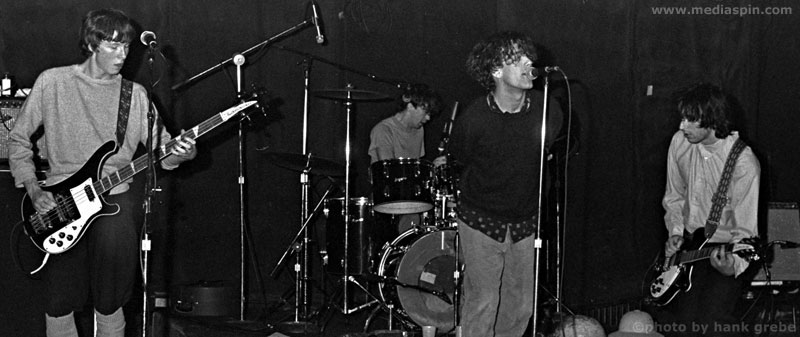
Hometown heroes enjoying their favorite Athens BBQ (1984)

In one of those twists of fate that can't be quantified, Merchant decided not to throw away the tape but to listen to it. What she stumbled upon was one of indie rock's best-kept regional secrets. Stipe, guitarist Peter Buck, bassist Mike Mills and drummer Bill Berry had all met at a U of G dorm party in the Fall of 1979 and had begun bashing out sweaty sets for free beer at local house parties since their first official "gig" at a friend's birthday bash on April 5, 1980. The cassette given to Merchant was a demo of cover songs recorded by the foursome at St. Mary's, an abandoned Episcopalean church at 395 Oconee Street in Athens. Merchant was intrigued by the nameless band's esoteric choice of cover songs: The Monkees’ “(I’m Not Your) Stepping Stone,” Aerosmith’s “Toys in the Attic,” The Velvet Underground’s “Pale Blue Eyes,” The Outlaws’ “(Ghost) Riders in the Sky” and Wire’s “Strange.” She reportedly was less impressed by the two original songs: “Action” and “Narrator (for a Jacques Cousteau show).”

Also impressive was the band's boozy, anarchic live shows at local clubs like Tyrone’s O.C. and the 40 Watt. They were (in)famous for changing their name every time they played and even had their fans scrawl suggestions on the walls of their church-squat: Twisted Kites, Can of Piss, Negro Wives, Sl*t Bank, Hornets Attack Victor Mature, Bingo Hand Job, It Crawled from the South, The Mystery Twins (a joke on the Jagger-Richards dynamic of the firey Buck and the withdrawn Stipe). The as-yet-nameless band was so beloved that they even popped up in a brief sequence in Tony Gayton's 1987 rockumentary Athens, GA-Inside/Out performing one of their more popular covers, The Everly Brothers “Dream (All I Have to Do)":


All the same, the band seemed not at all bent on "making it." Slackers at heart, they seemed perfectly happy inviting their fans to watch them rehearse in St. Mary's Church, toiling around town in anonymous day-jobs and being brief rock and roll heroes at night for some beer money and fleeting
adulation.

Merchant was immediately drawn to Stipe's unique vocal stylings – sort of a murmur mixed with a plaintive keen – and how his low-register voice mixed effortlessly in with Mills' high-lonesome tenor. Merchant rightly thought Stipe would make an interesting vocal foil. When she encountered him again working at Athens' now-shuttered Ruthless Records, she invited the 27-year-old clerk out to Los Angeles, where 10000 Maniacs were recording what would become their double-platinum album In My Tribe. Stipe made his first professional recording singing backup on “A Campfire Song." (A rare bootleg from May 1987 captures Stipe's live debut with Merchant singing "Campfire" and harmonizing on Gang of Four's "Damaged Goods" and John Denver's "Leaving on a Jet Plane" at McCabe’s Guitar Shop in L.A.)


Stipe also was invited to accompany Merchant on a duet on “Little April Shower” from the motion picture Bambi for Hal Willner's 1988 Disney tribute Stay Awake, further exposing him to college-rock audiences. In April 1990, she invited Stipe onstage at Merriweather Post Pavilion in Columbia, Maryland for an Earth Day show with 10,000 Maniacs and Billy Bragg. Stipe reportedly so wowed the crowd with his harmonizing on “Campfire Song” and John Prine’s “Hello In There” that he was added to a second show in Washington D.C., where he accompanied the Indigo Girls on “Kid Fears," George Gershwin’s “Summertime,” The Youngblood’s “Get Together” and Butch Hancock’s “Dallas.” These appearances went over so well that Stipe was summoned to Glagow, Scotland for a guest slot at the Big Day Festival:


Meanwhile, back in America, Stipe's bandmates decided to play their first official live show under their new name: R.E.M. debuted at the 40 Watt Club on July 13, 1990 as a threesome -- without Mike Stipe.

Buck, Mills and Berry would later joke that their live debut sans their lead singer was meant to put Stipe on notice that despite his new famous friends and higher profile he still had his responsibilites back home. This was the only public admittance that they felt threatened by their bandmate’s sudden success – especially when Stipe and Merchant became romantically linked in the rock press. (Both denied it, but Merchant later confirmed their brief fling in a interview.) The three musicians without a lead singer had decided on a permanent name: 'R.E.M.' (a medical acronym for 'Rapid Eye Movement') chosen at random from a dictionary. They continued in their vein of crowd-pleasing covers by launching what would become to be know as their annual “Christmas Club," a tongue-in-cheek ode to the record fan clubs of their youth. Handing out 7-inch singles to fans at live shows, R.E.M. became one of the first indie bands to embrace this practice unironically; it was later taken up by Pearl Jam and Smashing Pumpkins.

But with their new (and memorable) name, the three other members decided it was time to up the ante with more original songs. The early originals of R.E.M. are interesting in light of what would eventually develop as the band's "pre-fame sound": obscurist lyrics half-mumbled over jangly folk rock in a tense struggle with harder-edged punk and new wave elements, all evident in heavily bootlegged songs like “All the Right Friends,” “Burning Down,” "White Tornado,” “Windout,” “Ages of You,” and “Walter’s Theme” (the latter a bouncy, drunken attempt at writing a jingle for the band's favorite local BBQ joint). Even more fascinating is the very rare EP recorded in one afternoon in St. Mary’s Church when the band had called themselves “Chronic Town” for a hot minute. The song titles were never written down and have appeared in bootlegs under a variety of names (“Boxcars,” “One-Million,” “Nightgardening,” “Suspicion Yourself”). R.E.M. has since renounced these early songs, but the remaining evidence hints at an amazingly fertile and creative period -- a moss-dripped, Southern Gothic mutation of The Byrds and Roky Erickson -- that is all the more tragic for being so poorly documented.


But R.E.M., with Stipe returned from his European jaunt with 10000 Maniacs, was already moving on to its next pre-fame phase. Merchant’s influence had gotten the band some prime studio time with producer John Keane in Athens for five days in mid-July 1990. Did lightning strike this time? Oh hell no.

By all accounts, the sessions were a disaster. After playing in a converted church and in tiny rock clubs for close to a decade, R.E.M. were not yet prepared for the rigors of a full-blown studio and the sessions yielded only half-ideas, wisps of songs, and maybe a few rough gems that only hinted at a growing maturity: “Fretless” (an instrumental), “Mandolin Strum," “It's A Free World, Baby,” “Low,” “I Walked With A Zombie,” “Country Feedback” (a song that would resurface later in their careers), “Speed Metal,” “Organ Song,” “Kerouac #4." Although these demos have been bootlegged in countless forms, only three songs were salvaged from these sessions: “Ghost Reindeer in the Sky” and “Summertime” would be re-recorded and released as the 1990 Xmas club single, and a version of the melancholic “Fretless” with added lyrics would be chosen for a plumb spot on the soundtrack to Wim Wender’s Until the End of the World.


But did R.E.M. rose to the challenge of these disappointing sessions? Yes, by doing nothing. For two years.

While grunge blew up around them and major record labels scampered to the Pacific Northwest to sign anything in a lumberjack shirt, long-johns and white-guy dreads, the aging foursome now poised to break out into pop stardom retreated to their local Athens cocoon and played only a handful of mostly private shows (including a "birthday party" for a friend's pet ferret) while the indie press who had followed their strange but fascinating rise were left to wonder: “Does R.E.M. -- if that is indeed their real name this week --have the stones to go all the way? Does R.E..M. even exist? Are they just Natalie Merchant's hobby project?” A few vicious parodies appeared in the alternative music press, the most famous being from the Milwaukee zine Drool Pail, where a cartoon depicted Merchant as Cruella de Vil leading Stipes on a short leash:


It was a bold move that many would think would not pay off. In the end, however, it wound up strengthening R.E.M.'s indie cred at a time when bands were selling out left and right and “Modern Rock Radio” was defanging the indie revolution at a worrying pace. Like many other established bands caught on the wrong side of that revolution, Natalie Merchant and 10000 Maniacs was seen by many as part of the pallid Adult Contemporary market. But for the moment, the boys of R.E.M (now in their early thirties) stayed firmly tethered to her star. A turning point for the band was when Stipe was invited to perform “Candy Everybody Wants” and a cover of Lulu’s “To Sir, With Love” with 10000 Maniacs for MTV’s Rock and Roll Inaugural Ball on January 29, 1993:


Watching the rehearsals, U2 bassist Adam Clayton and drummer Larry Mullen Jr. were so impressed by Stipe’s vocals that they invited the singer and a tagging-along Mike Mills to back them as the one-off supergroup “Automatic Baby” for a version of “One.” The performance was seen by millions, many of whom were now asking after the sad-eyed singer in the old fedora:


Reinvigorated by the new attention, R.E.M. entered the studio with new producer Scott Litt in August 1993 for another attempt at some new material. The sessions started tentatively, with songs like "You," "I Took Your Name," "Yes, I Am Fucking With You" (later retitled "The King of Comedy") emerging with almost adverse caution. On the basis of these demos (fleshed out by an inspired cover of Iggy Pop’s “Funtime”) and the band's Next Big Thing status amongst music-industry insiders, R.E.M. was able to secure a recording contract with Warner Bros. Records, and everybody held their breaths as to how a major label would mess up and destroy yet another beloved and idiosyncratic grassroots rock act.


By October 1993, the same month the latest Merchant/R.E.M. collaboration “Photograph” (a song with remnants of the group's under-recorded "jangly" period) appeared on the Born to Choose compilation, R.E.M. were at Kingsway Studios in New Orleans, where the trickle had now reached a torrent: Here the band would compose "Tongue," "Crush With Eyeliner" and "What's the Frequency, Kenneth?" and put twenty tracks in the can over ten days. But despite this promising start, storm clouds were already gathering on the horizon for the New/Old Band That Might Finally Make It.

By March 1994, R.E.M. took a break from recording to begin a series of high-profile Industry showcases and one-off promotional "secret" concerts designed by their new label to capitalize the MTV/Merchant/U2 buzz -- a move that would cost the band's reputation dearly later on. Also, April 1994 turned into the cruelest month for Indie Rock with the suicide of Kurt Cobain, whom Stipe had met and befriended backstage when Nirvana had come through Athens to promote its first full-length album Bleach. That month, R.E.M. debuted the song "Let Me In" live at a special concert in Seattle as a tribute to the young guitarist, whose sudden, massive fame had dovetailed lethally with lifelong depression and heroin addiction.


Although R.E.M. was drug-free and (mostly) depression-free, in less than a year they would be dealing with many of the same instant pressures that had brought down Cobain. And it would have equally dire consequences for entirely opposite reasons.

STAYED TUNED FOR PART II: "Monster Success, Monster Money, Monster Problems"