Showing posts with label The History of Music. Show all posts

Tuesday, June 4, 2013

La Storia Completa E Totale Di Musica (Pt. 4)


Medici House Band
 
The Beast has an ongoing series we haven't done for awhile called The Complete & Utter History of Music on YouTube, which was meant to educate ourselves as well as entertain y'all. We just returned from a Spring hiatus to Italy and would like to add on a post on the places we visited that fit into the overall narrative. Especially since we found ourselves in two cities known for their museums tracing the origins of our modern instruments: Bologna, called Italy's "city of Music" and Florence, where the piano was invented. Score!

Bologna is dominated by the local university and like Austin, TX or Chapel Hill, NC (or even Xalapa, Mexico) still has a vibrant music scene. Only Bologna's music scene goes back about, oh, a couple thousand years. Always a bit of an artsy, proudly Leftie city -- we arrived in the midst of the annual May Day Festival in the main Piazza Magiorre, where a band was rolling through an Italian version of "The Ghost of Tom Joad" before an enormous banner proclaiming Lavoro, Sviluppo, Legalità ("Work, Development, Legality") and a lot of young white hipsters bearing wraparound Italian sciarpas and t-shirts proclaiming "Basta!" ("Enough!" -- some sort of local anarchist cry). They were the inheritors of a city who had seen many great musicians -- Ottorino Resppighi, Gioacchino Rossini (who debuted at age 13 in 1805 at the city's Teatro del Cortso), Gaetano Donizetti, Padre Giovanni Battista Martini and even Wolfgang Amadeus Mozart -- who have either lived, studied or performed in Bologna. The Academica Filarmonica, founded in 1666, included Rossini, Wagner, Verdi, Puccini, Liszt and Brahms as members.
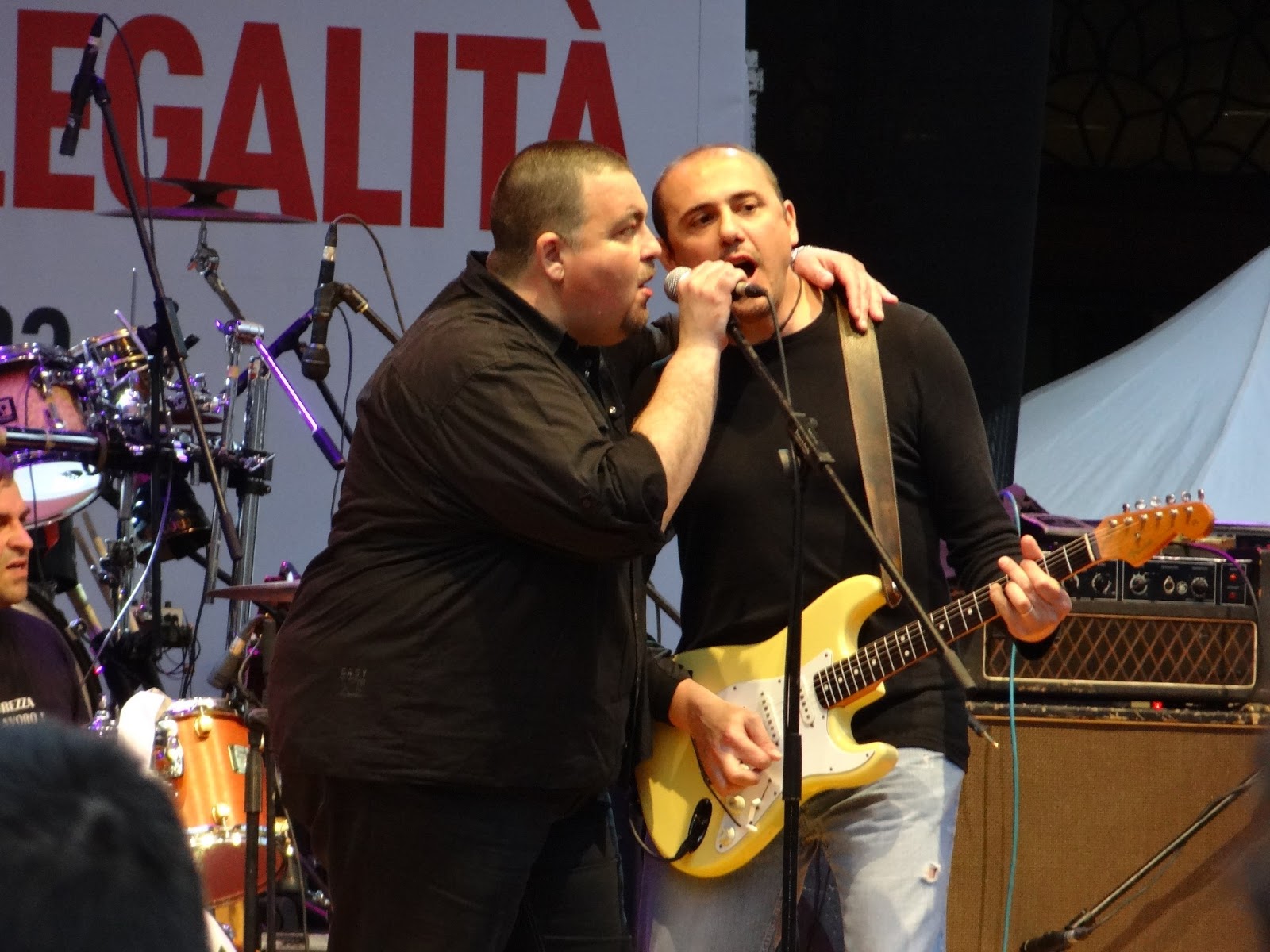
"...alla ricerca del fantasma di Tom Joad"

We caught a snootful of Northern Italian Hip-Hop at Arteria, a small club right by the University with a dizzyingly quick lineup of bands like BoomBap Haze, Ribbores, E-Green and Brain. (Note: Italian hip-hoppers don't say "yo-yo-yo" but "ya-ya-ya" and it's not at all annoying; they also give shout outs to their own band names at least every other line, almost double that of American rappers). We stood sipping on a Bierra Moretti and watched this cavalcade from a giant cloud of marijuana smoke in the basement of some ancient crumbling dance club. Just two blocks away on Strada Maggiore was the International Music Museum and Library, where the Beast and Mrs. Beast had paid a visit to just a few hours before. The place contains about six centuries of well-preserved musical history in the stunningly restored 18th-century Palazzo Sanguinetti; the entrance is through a grand-domed staircase where hundreds of tiny stars hang from thin wires and give the impression they are floating in midair:


Of course, this was only prelude to the goodies inside. There;s the Harmonice musices odhecaton A, the first musical instruction book printed with movable type by Ottaviano Petrucci in 1501, an anthology of French-Italian chansons that made printed music available to the masses, where previously it had been the province of vanity luxury items of the very rich. (Essentially, the Rosetta stone to all those Mel Bay books we grew up with.) There's Rossini's autographed original score to Il Barbierie di Siviglia. There's the entrance examination from to the Accademia Filarmonica by a young Wolfgang Amadeus Mozart that he, under the aegis of his mentor Padre Giovanni Battista Martini, submitted on October 9, 1770; apparently, the young prodigy failed to understand musical counterpoint and Martini, who just happened to be one of counterpoints pioneering theorists, had to pencil-whip it into shape to his student could pass. (A few months later, the 14-year-old Mozart, who had already dropped out of the Accademica, debuted his opera Mitridate in Milan.)


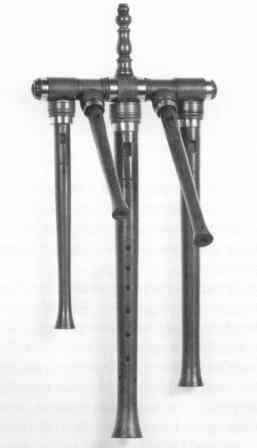
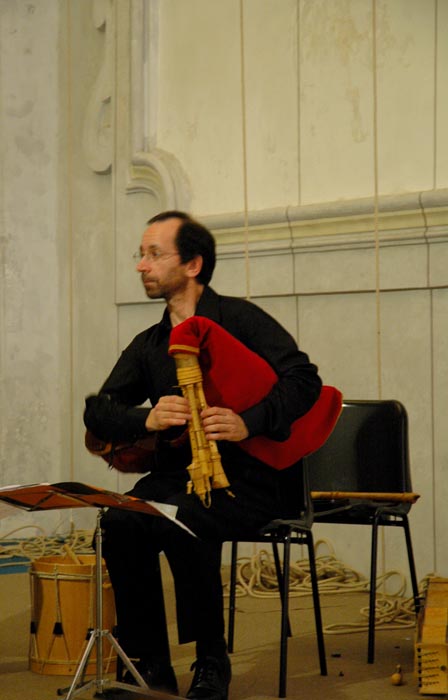
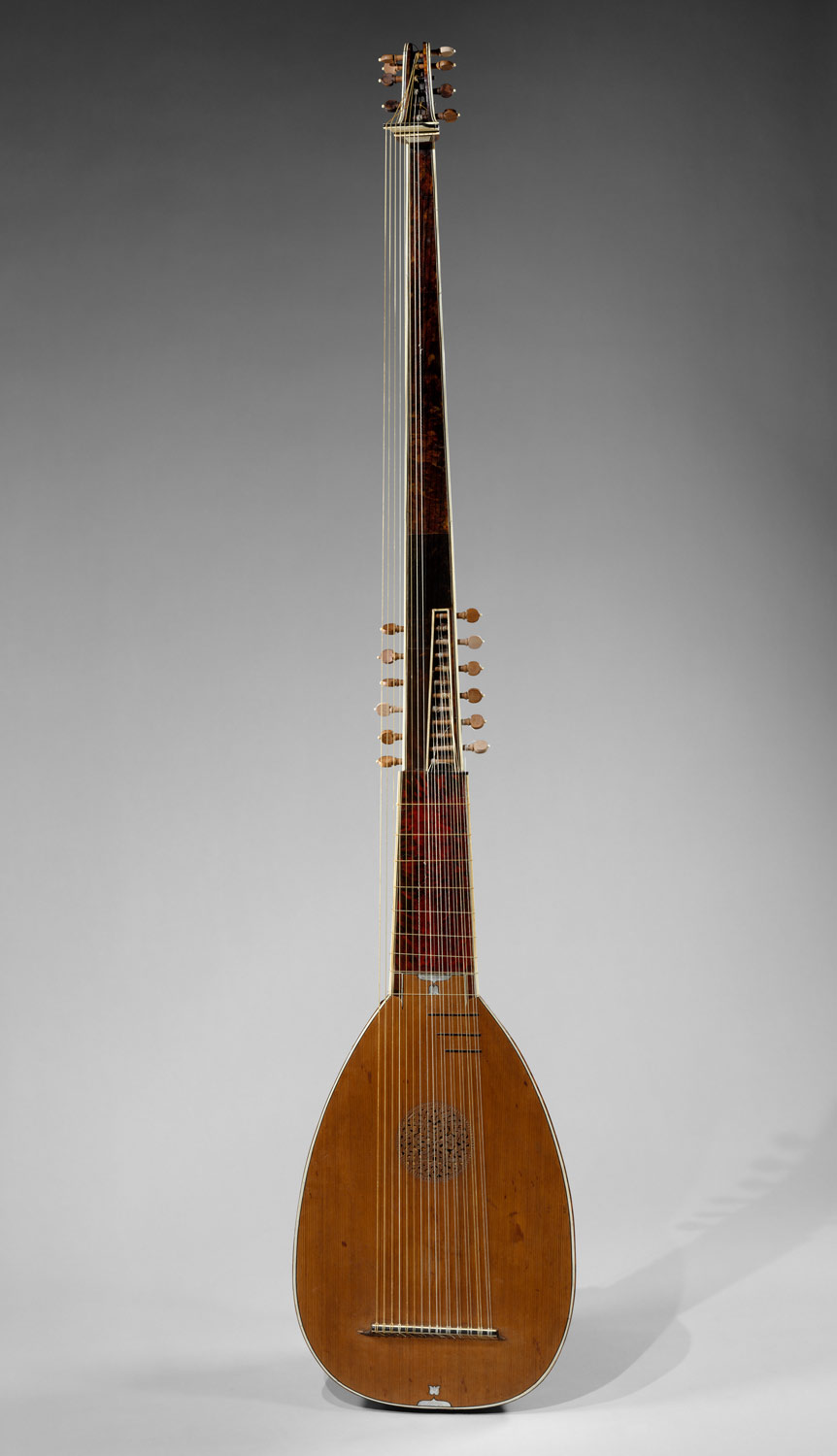
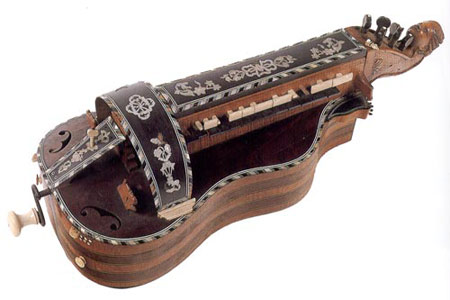
But the best part was its collection of musical instruments, including an amazing pair of chromatic double-harps [pictured above] -- one carved in maple; the other sculpted from pine into the figure of a female -- that were the antecedent to the piano. There was a diverse assortment of five-piped flutes (Armonia di flauti), the sordellina, which is a set of bellows with numerous boxwood pipes that resemble lobster claws, and stringed instruments like the Archlute, a pineapple-shaped soundbox with an impossibly long neck and a wonderfully complex interweb of single and double strings. There were such truly rare and esoteric inclusions as the Heckelphone (sort of a giant oboe), an omnitonum (monochord) harpsichord created in 1606 by Vita Trasuntino, a series of pochettes (small violins used by dancers), and of course, that Sting/Arcade Fire-revived/Donovan name-checked hipster instrument the coppia di ghironde ("hurdy-gurdy"), popular with court dancers and street beggars alike in the 16th and 17th centuries that looks like a large pepper grinder and makes music much the same way, by rotating a rosined wheel inside a hollow wooden box.


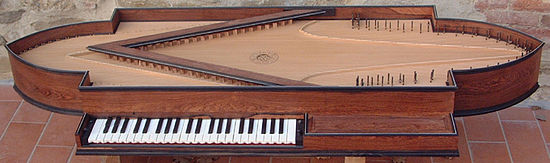
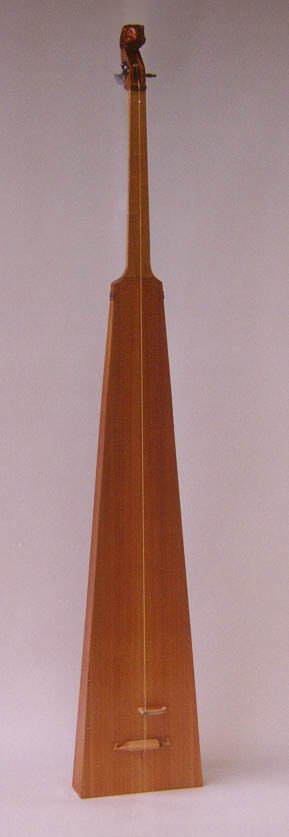
We continued our musical-instrument tourism in Florence at the Galleria dell'Accademia, which holds a mouth-watering array of swag from the powerful Medici and Lorraine clans. Much of the collection comes from Grand Prince Ferdinando de' Medici (1663-1713), who was more of a music and arts lover than his politically charged family. Among the treasures was the salterio, a sort of flat box engineered from different types of marble that contains twenty strings to be plucked or strummed (the antecedent to the hammer dulcimer and the autoharp); a spinette ovale, built in 1690 by master Florencian craftsman Bartolomeo Cristofori (1655-1732) out of rosewood and cypress, a rectangular case with Gothic-arch sides containing symmetrical strings with a small ivory keyboard (the antecedent, we surmise, to the Casio portable keyboard); a pianoforte vertical [pictured above] that was basically a grand piano with the entire case folded straight up in the air in a spectacular "giraffe" shape; a serpentone, which is a bass horn constructed out of leather and chestnut wood in the form of a long snake; a corno di bassetto that looked like a clarinet with hinges; the tromba marina, which is sort of like a piece of clock-shaped furniture with a single bass string (shades of the diddley-bow) that when plucked or bowed apparently sounds like a trumpet (??); a splendid pair of hurdy-gurdies carved out of mahogany and overlaid with mother-of-pearl; and our personal favorite, a strange little character called the chitarra a pianoforte [pictured below] which is like a teardrop-shaped lute with a tiny little five-key chromatic keyboard mounted right above the bridge; apparently, this was constructed by a London guitar maker who was asked to create an instrument "suitable of girls of good families" that would safeguard their soft fingertips.


Oh, and there were also a bunch of churches, museums and ancient ruins and stuff.

Tuesday, July 17, 2012

TUBE OF SONG: The Complete and Utter History of Music on YT (Pt. 3)


Isn’t it odd that the musical dichotomy we know now as Mainstream vs. Indie was established during the High Middle Ages? Back then it was called “Sacred vs. Secular.” The music we saw in the last post was all sanctioned by the Catholic Church, whose dominance over music and musicians was sort of like Universal Music Group’s dominance of music and musicians 700 years later.

Cue a bunch of plucky indie outsiders traipsing all over the south of France, accompanied by jugglers and singers, strumming their lutes and lyres on secular (i.e., “not churchy”) songs, based on old romantic poetry. They wooed peasant girls and bored castlefraus alike with tales of chivalry, ribaldry and Courtney Love….excuse us, “courtly love,” which is the medieval version of “hooking up” that often drew complaints from the Church itself. Their music was based on existing sacred musical forms but, like some Middle Ages version of bluegrass music, it was sped up and used the vernacular of the common people. Understandably, these constantly touring folkies were popular and got to play at all the wealthiest estates, even inspiring other regional secular music movements in Spain, Greece, Italy, Germany and Portugal. Nowadays they’d be call “freeloaders” or “hoboes” or “get-out-of-town-if you know whats good for yous” but back then, right before The Black Death wiped most of them out, they were hailed as The Troubadours. These wandering nymphs even broke up into their own sub-genres: the canso (love song), the sirventes (political song) and the tenso (a “debate” song between two or more singers).

One of the oldest known troubadours was Piere d'Alvernhe, who was even shouted out by name in Dante’s Divine Comedy. The oldest troubadour whose work survives is Guilhem IX, the Duke of Aquitaine:


Bernart de Ventadorn, possibly the son of a castle baker, developed and formalized the canso, a sort of three-part folk song that became the basis for the troubadour style of courtly-love lyrics:


Giraut de Bornelh, who was from a lower-class family, became the master of alba, a plaintive form of lament for lost love or life:


But it wasn't all serfs and commoners who became influential in the Troubadour style. Bertran de Born was a baron who wrote sirvientes:


In Northern France, a more aristocratic style of the troubadours' secular song was being developed under a different name, Les Trouveres. One of the most famous was Adam De La Halle:


What’s more, there were a good number of female troubadours (called “Trobairitz”), often countesses or wives of noblemen, who specialized in even more categories, such as the planh (funeral lament), the salut d’ amor (love letter), the alba (dawn songs) and balada (dance songs). The most famous of the females – the Lady Gaga of the Trobairitz, if you will – was Contessa Beatritz de Dia, and her song "A chantar m'er de so qu'eu no volria" is the only canso from a female troubadour that survives to this day:


Unfortunately, the Church had to step in and end all of this fun with the Albigensian Crusades, which Pope Innocent II (not his real name) launched to eliminate heresy in France. The side effect was that a lot of the Troubadours got their timepieces cleaned. But just walk into any open mike night at any boho coffee grotto in any city and you will see the tradition as alive as it was when modern Troubs like Robert Johnson, Son House, Charley Patton, Blind Lemon Jefferson, Woody Guthrie, Leadbelly, Joni Mitchell, Bob Dylan, Townes Van Zandt, Ramblin’ Jack Elliott, Emmylou Harris, Odetta, James Taylor and Bruce Springsteen took it to America.

Friday, June 29, 2012

TUBE OF SONG: The Complete and Utter History of Music on YT (Pt. 2)


Thanks to godless Eurpoean hordes with punk-rock names like Huns, Vandals and Visigoths, the mighty Roman Empire fell on on Sept, 4, 476 A.D. (yep, we have an exact date for that). Unfortunately, the Roman Catholic Church rose to take its place, and began to centralize all of the various musical styles that accompanied regional religious rituals, like the Celtic Rite, the Mozarabic Rite, the Ambrosian Rite and the Gallican Rite. Their main similarity was that they were all a vocal form called “Plainchant,” which is exactly what it sounds like: a single line of melody -- one! -- with no musical accompaniment -- none! To make a VERY long story short, a few of these heathen styles melded with the dominant Roman rite to produce around 750 A.D. what we now know today as a million-selling post-yuppie aromatherapy spa/coffee shop fad: the GREGORIAN CHANT.


Hell, it was a fad then, too, and it's hard not to see why. The Gregorian chant involves the innovation of a number of voices singing in unison at the same pitch and rhythm, all a cappella. It was so popular -- imagine monks, nuns and choirs as the rock stars of their day -- that it remains the official chant of the Roman Catholic Church to this day. It also became the bedrock for all Western music that followed. Unfortunately, this includes the most recent fad of Gregorian monks singing songs like "Tears In Heaven," "Boulevard of Broken Dreams," "Sweet Child O' Mine" and "Bad Romance." Lord have mercy...

Modern equivalent: The Cure's "Plainsong"; The Electric Prunes’ “Kyrie Elison”; Mr. Mister’s “Kyrie”; Enigma’s “Sadeness (Pt. 1),” The Benedictine Monks of Santo Domingo de Silos’ Chant; Ace of Base’s “Kyrie Eleison”; the theme for Medieval II: Total War


Around 900 A.D., a more complicated style of Plainchant called ORGANUM emerged to challenge the old Gregorian fogeys. Organum took existing Gregorian chants and embellished them with a second melodic line parallel to the original -- quite possibly the earliest example of "sampling" in human history. Not only that, Organum was originally improvised, with one cantor singing from the notated score and another coming in with on-the-spot parrallel melodies -- namely, jazz singing by medieval cantors. Later, innovative theorists like Johannes Cotto and Guido D'Arezzo published texts that added the innovations of contrary voices moving in opposite directions and well as similar directions at different intervals. This was called "Free Organum" and it was instrumental in developing the Western musical concept of "counterpoint," or musical lines that move independently of one another:


Increasingly complex forms of organum building to a steam-head in the 12th Century A.D. with the construction of Notre Dame Cathedral in Paris. Like Motown Records 715 years later, the cathedral produced a stable of composers who deepened the polyphonic well, the most famous of which were Leonin and Pérotin, who were sort of like the Brian Holland-Lamont Dozier of their day. Pérotin, in particular, produced the first-known four-voiced organum:

Monday, June 25, 2012

TUBE OF SONG: The Complete and Utter History of Music on YT (Pt. 1)


PROLOGUE: Formation of the Earth from The Tree of Life (2011 A.D.)
Because, why not go back to the very beginning? FYI: The score is “Lacrimosa” by Polish composer Zbigniew Preisner, who wasn’t alive when the earth was formed but did a darn good job of imagining how it would be played by an orchestra.


Among the many, many theories about how music evolved on our planet is that of the repetition of sounds that predated actually putting notes together. One of the main ones was RHYTHM, which many argued came from the pre-literate beating of apes on logs, their chests, the ground or each others backs to show dominance and aggression and mark their territory – not to mention announce that they are horny [above]. As for the HARMONY AND MELODY side of things, some experts claim the dual influence of natural sounds like bird calls and elephant roars [below] and the exchange of sounds between mothers and infants, human or otherwise.
Modern equivalent: Drum Circles; Zoos; Maternity Wards.


Then, there was the problem of LYRICS, which the Hebrew Bible provided with its 150 Psalms, the oldest of which is Psalm 90 [above], which Moses allegedly composed it as a plea to the Big Guy Upstairs to get him and his flock out of the goddamn desert after 40+ years.
Modern equivalent: Jane Sieberry’s “Calling All Angels”; Paul Robeson’s “Let My People Go”; just about any blues song ever written.


“HURRIAN HYMN NO. 6” (approx. 1225-1400 B.C.)
This is the oldest known melody on Earth [above] in reasonably complete form, uncovered on clay tablets in the 1950s from what is now present-day Syria, part of 36 hymns praising the Nikkal, the Semetic “goddess of the moon.” So the first known song was composed in honor of a chick – and an imaginary one at that.
Modern equivalent: T-Pain’s “I’m N Luv (Wit A Stripper)”; Prince's "Cindy C"; The Penguins' "Earth Angel"; Roy Orbison's "Oh! Pretty Woman"; Train's "Drops of Jupiter."

DELPHIC HYMNS (approx. 138-128 B.C.)
In 1893, these two choral hymns [below] – basically odes to Apollo, the God of Light and Sun – were found inscribed in a stone wall in the ancient Greek city of Delphi. They are considered the first “unambiguous” examples of musical composition in that they both survived nearly intact and bore the names of their respective composers: Athinios and Limenius, both from Athens. Limenius is the more well-known, due to some confusion over the spelling of his colleague's name, and was believed to be a professional musician who was required to belong to the Artists of Dionysus guild, basically an early example of the pain-in-the-ass Musician’s Union except with more wine and sex.
Modern equivalent: The Beatles' "Sun King"; Vangelis’ “Oracle of Apollo”; The Polyphonic Spree’s “It’s The Sun”; Sheryl Crow's "Soak Up the Sun."


“SEIKILOS EPITAPH” (approx. 100 B.C.)
Another find from Ancient Greece [below] – which would later give us Vangelis, Yanni and Xenakis – is considered the oldest complete musical composition (including musical notation and the melody being "recorded" – namely, engraved – with its lyrics) discovered in 1883 on a tombstone in Turkey. The composer Seikilos purportedly wrote this in tribute to his dead wife Euterpe: ‘While you live, shine / Have no grief at all / Life exists only for a short while / And time demands his toll.’
Modern equivalent: Christopher Cross’ “Think of Laura”; Rascall Flatts’ “What Hurts the Most”; Wayne Cochran's "Last Kiss"; Henry Gross' "Shannon."