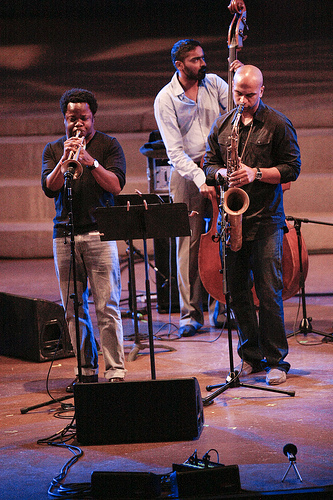
Showing posts with label Angel City Jazz Festival 2012. Show all posts

Tuesday, October 16, 2012

ANGEL CITY JAZZ FESTIVAL 2012: Silence Has A Sound

Every year at the Angel City Jazz Fest, Deborah Drooz, our blog bud Greg Burk’s cheekymonkey better-half, swipes my notebook and scribbles a quick silly drawing. Here’s this year’s installment of “Drooz’s Doodlez”:


We assume this is: (a) Barack Obama; (b) Juan Epstein from Welcome Back Kotter; or (c) “ObamEpstein.”

Barring Saturday night’s live-soundtrack performance by guitarist Bill Frisell, the final weekend of the ACJF’s “Artists & Legends” concert series brought the 88 keys of the piano to center spotlight—piano as deconstructed and rebuilt by three successive generations of players: Marilyn Crispell, Myra Melford and, closing out the festival’s last night, Vijay Iyer.

Marilyn Crispell

All three pianists are fiercely smart, relentlessly curious and open to vanguard ideas, and intellectually equipped with an encyclopedic knowledge of the history of their chosen instrument – basically, every Romney-Ryan supporter’s worst nightmare of “the Lofty Left.” Marilyn Crispell emerged alone onstage for the beginning on Friday night’s program at REDCAT, bowing graciously before lighting up the keys for a forty minute improvisation. There was no rhythm section , no groove or pulse to graft onto or pocket to fall into, just tumbling, escalating, dissonant tones and clusters intertwined with lyrical ECM New Ageisms like a double helix, a de facto guided tour of Crispell’s influences: Cecil Taylor (who plays REDCAT next week BTW), Keith Jarrett and Anthony Braxton, whom Crispell made her name with in the 1980s. (Dare we say we caught traces of George Gershwin and George Winston in there too?) Sitting just to stage left, the Beast was able to spy the reflection of Crispell’s hands in the shiny dark wood of the upturned keyboard cover. (They appeared disembodied and dancing in the dark, like a routine from The Electric Company or Ernie Kovacs.) Like wandering but united twins, they never strayed too far from one another – the right slightly more aggressive, like it was straining on a leash, while the left kept the more steady pulses. The trick, we surmise, is to not get caught in a mental roundabout, where one is trapped in a Moebius-circle where one’s improv options decrease exponentially. Crispell seemed to be settling into a pattern of avant-garde iciness mixed with lyrical beauty (including some snatches of Tin Pan Alley), not integrated but in blocks: ‘playOUT-playIN-playOUT’. She dove into a furious salvo of single-fingered notes hammered out double-time until the reflection of her hands blurred. Then she dropped the soft last note like a feather.

Myra!

A second bench was set up for Myra Melford, who emerged with Crispell for “Piano: Four Hands,” which they performed before. Essentially a divide-and-conquer duet, with Melford on the lower-register 44 and Crispell manning the upper, playing tight in tandem but with little variations so swift and deft they were easy to miss. Melford was obviously energized to be sitting next to one of her heroines, moving her head and shoulders back and forth as she played and mouthing her lines with gusto as she played them. Both artists finished this brief interlude with bows and held hands.

After an intermission came Melford’s bewitching new Pacific Rim-flavored ensemble Snowy Egret. The sextet began with a 40-minute uninterrupted suite of compositions -- "The Promised Land," "Snow," "The Kitchen," "The Virgin of Guadalupe" -- interspersed with open improvisation. These were distinguished by trumpeter Kirk Knuffle’s mellifluous constricted tones, guitarist Liberty Ellman’s warm jazzy lines and Stomu Takeishi’s daps and pops on his oblong, pear-shaped acoustic bass. The sixth musician played no instrument: the butoh master Oguri provided a sort of counterpoint to the band, freezing like one of those creepy statues from Doctor Who while the music was at its most lively, and flailing about in marionette-sans-strings fashion when things grew quiet or subtle. The elliptical "A Musical Evening at the Concepcion Convent," blew away any conceptions of stucture or melody, with Melford triggering eerie sampled whispers ("green light...green trees...green leaves...silence has a sound") while Oguri executed a crabwalk with a chair held tightly under his ass. Drummer Tyshawn Sorey's solo was the centerpiece of "The First Protest": kicking in with the kind of mongoose-hiss you hear when you open a new can of tennis balls, switching drum sticks with mallets with brushes and even the palms of his hands so swiftly it was like watching sped-up drawings in a flipbook.

Right before she introduced the Vijay Iyer Trio on the following Sunday night, new CAP UCLA Artistic Director Kristy Edmunds aptly summed up the evening-to-be to the crowd at Royce Hall: “It will only ever happen this way once.”

[all photos courtesy of Myles Regan]

Iyer took the stage looking like a cosmopolitan, Grammy-winning, grant-magnet jazz artist at the top of his form should look, dressed in a crisp, shiny grey suit and bright orange shirt, thin, wiry and youthful (despite the fact that he’s forty-one) and boiling over with promise. Before beginning the ambitious, 13-song set with a dewy, mysterious prologue called simply “Lude” (as in pre- not quaa-), Iyer acknowledged the crowd with Ellingtonian deference: “I came to listen to you guys, and I hope to hear you out there tonight.”

Vijay Iyer, Stephan Crump, Marcus Gilmore

The trio easily slid into “Accelerado” and the 70s’ funk cover “The Star of the Story,” songs from Iyer’s latest CD that they’ve been bending and twisting into varying forms in concert for the last few years. (That’s the thing about jazz: you never have to play the same song – even if it is the same song – twice.) For the latter, Iyer employed a soft pre-recorded drum loop that opened up his accompanists to all sorts of slithering inside and out of the rhythm: Stephan Crump running tickling hands up and the neck-strings of his bass; the amazing Marcus Gilmore unfurling double-time brush strokes on his drums that hit one’s face as fresh as sea spray. Iyer, deep in concentration like a Los Alamos scientist, constantly pushed ballroom-like flourishes against the tense, frisky rhythm section. For the anti-ballad “Up On This,” Crump hit upon a striking, spectral sob from his bass that one wanted to clap for but didn’t – not want to bruise the bracing, living-in-the-millisecond mood. Each of the players took solos, but they did not spin off into Endless Improvland, instead conserving their energy for short bursts, like fireflies lifting off for brief sorties before re-alighting on the mothership.

Steve Coleman

“Phase Two” began with the appearance of Iyer’s chosen legend for the evening, alto saxophonist Steve Coleman. Coleman, who came up towards the end of the Loft Jazz Scene in New York of the late-70s/early-80s, looked like he just came over from the Brooklyn G Line in tee-shirt, khaki jacket and trademark backwards baseball cap as he bit into Iyer’s “Morphology” and "Habeus Corpus," using his particulated sax bleats like a punctuation marks to test and tease the creeping-panther melody. “Passage” was a floating, amniotic duet between Iyer on Fender Rhodes and Graham Hayes on ghostly, Bitches Brew-inflected flugelhorn. Arguably the evening’s showstopper was “Hood,” dedicated to the late Detroit DJ Robert Hood, an extended motorik jam drawn out on a one and two-chord progression set by Iyer that he kept repeating insistently and hypnotically. The whole group – now expanded to a sextet with the addition of Hayes and Herculean-lunged tenor saxophonist Mark Shim – mimicked the electron-pulse of Detroit House while weaving in quick snatches, squiggles and bytes of abstraction, like Sun Ra’s orchestra mating with Kraftwerk in George Clinton’s living room. They closed with the equally frantic "Good on the Ground," with each solost chasing each other over a piledriver fusion-funk workout.

Mark Shim, Coleman, Graham Haynes

 
And the thing about Iyer: He never once uttered the word "Jazz" all evening. Welcome to the future, y'all.

Wednesday, October 10, 2012

ANGEL CITY JAZZ FESTIVAL 2012: Let The Music Take You

Shepp Sings!
[all photos courtesy of Myles Regan]

On Sunday night, two sort-of uptight ladies (in the jazz parlance of yesteryear: “moldy figs”) are sitting eating from plastic clam shells filled with chicken salad next to one of those giant open ‘EXIT’ doors at the John Anson Ford Amphitheatre. Onstage, trumpeter Ambrose Akinmusire’s quintet is taking a pause while their baby-faced drummer Justin Brown is introducing himself to the open-jawed crowd with a thunderous, extended drum solo that’s half Art Blakey, half Speed Metal. The lunching ladies seem stunned frozen with their sporks by the four-armed ferocity of Brown's attack. Then, one slowly gets up and walks slowly towards the open door as if transfixed. And closes it.

There was so much music spilling out of every crevice of the Ford Amphitheatre on the Angel City Jazz Festival’s third day of celebrating modern jazz Artists and the Legends who inspired them that one might have be tempted to find an Exit just to catch one’s breath. (Read our account of the second night at REDCAT here.) But even outside the theatre on Edison Plaza there was music, a collection of smaller combos under the banner of Gary Fukishima's L.A. Jazz Collective. The only answer? Submit.

Vardan Ovsepian, Damian Erskine, Peter Erskine

The concert started out like a fox in the late-afternoon, perfect-for-a-picnic-basket sunshine with a new trio led by ex-Weather Report drummer Peter Erskine with his bassist nephew Damian Erksine and pianist Vardan Ovsepian, who unfurled songs from their new CD Joy Luck, including a subtle and slippery cover of Jerry Goldsmith’s theme for the 1950s TV show Dr. Kildare. Ovsepian, alongside Tigran Hamasayan, is part of an interesting trend of fierce young Armenian jazz pianists; both splice in dissonant tones alongside breathtaking waves of classical lyricism and a scent of Eastern Europe folk traditions (i.e., gypsy angst). Erskine The Younger took brief guitar-like solos with his custom Skjold electric bass that recalled Jaco Pastorius’ more restrained moments. At the end of the set, Erskine The Elder called out a ‘Happy Birthday’ to the great Chicago drummer “Papa Joe” Jones.

Mr. Arco: Mark Dresser

The performances grew with intensity as the hills behind the stage grew dark and the stage lights conjured up long shadows on the rock walls. Next up was a quintet led by double-bass guru Mark Dresser, up from his teaching gig at UC San Diego. Throughout the band’s opening salvo – an exotic segue of “Digestivo” into “Telemojo” followed by “Rasaman” – Dresser executed stinging slides up and down his double-bass bass neck that intertwined with the spindly, sandpapery sounds of Denman Maroney’s “hyperpiano.” (Essentially a grand piano tricked out to be played on almost every surface.) Dresser had pulled saxophonist/clarinetist Marty Ehrlich back from New York, and along with special guest Legend (and former teacher of both men) Bobby Bradford, relived their Pomona College glory days back in the early 1970s playing in the ad-hoc free jazz collective Black Music Infinity with Stanley Crouch. They paid tribute to Bradford with a tempo rubato take on the cornetist’s “Comin’ On” and “BBJC,” a song dedicated to Bradford’s late musical partner, clarinetist John Carter from Dresser’s 1994 “Castles for Carter” suite. Ehrlich might have been the only clarinetist one could think of (Ben Goldberg a close second) who could match Carter’s infamous high-pitch, warped-NOLO clarinet runs.

Dresser, Mr. Bradford, Michael Dessen
 
The next quintet was a perfect example of men working apart together. The sax-trumpet duo of Ambrose Akinmusire and Walter Smith III played their melodies in tight tandem, like the close and telekinetic interplay of Wayne Shorter and Freddie Hubbard from the Jazz Messengers or even that of Shorter and Miles Davis in Davis’ mid-60’s quintet. Akinmusire performed just two songs from from his critically lauded 2011 CD When The Heart Emerges Glistening in favor of new material. (The kid's young; he's probably written four songs by the time you read this) He stood behind the band during the solos before stepping up to deliver a trumpet sound that aped Davis’ short lyrical bursts while retaining Clifford Brown’s metric complexity – but with a sharp, piercing toreador tone that brined with new ideas all his own.
 
Ambrose Akinmusire, Harish Raghaven, Walter Smith III

The headliner, promethean New York saxophonist Archie Shepp, hadn’t graced an L.A. stage since 1986, and he seemed to be re-acclimating himself as he sat patiently on his stool for at least ten minutes while he and the band tweaked the sound engineers with twists of their fingers and quick nods. Looking like a Kansas City hepcat in a loose-fitting blue-grey suit with long coat and matching fedora, Shepp extended a hand (or maybe a middle finger) to the hometown crowd with “Hope 2,” a song dedicated to the late, under-appreciated pianist Elmo Hope, who decamped from New York to L.A. in 1957 when he lost his cabaret card -- only to return four years later when he found L.A. too creatively frustrating. When Shepp soloed, on could hear the collective sigh, Ah, there it is. Shepp, leaning back on his perch, played deep oakbarrel yawps on his tenor sax. And then, depending on who you later asked, something quite extraordinary happened.

Akinmusire, Avery Sharpe, Shepp

Shepp was known back in the ‘60s and ‘70s for his turgid, Afrocentric “fire music,” his outspoken (and often profane) criticisms of American racism and his unforgettable 1965 appearance on the free-jazz Rosetta stone, John Coltrane’s Ascension. (He once composed a song about Malcolm X titled “Rufus (Swung His Face at Last to the Wind, Then His Neck Snapped)”.) Yet, with a swingin’ backup more suited to the Cotton Club, Shepp popped his sax back in its holder, took the mike, stepped off the stool, and began to sing Duke Ellington’s “Don’t Get Around Much Anymore,” snapping his fingers, digging in with ribald growls in a deep baritone halfway between blues singer Jimmy Witherspoon and Clint Eastwood’s favorite jazz singer Johnny Hartman, getting the crowd into the act for the first time all day. He did it again with a Billy Strayhorn ballad. (Apparently, he’s been singing a lot in concert lately.) Despite the alternating expressions of joy and horror in the audience, Shepp was actually having fun. He was paying heed to his “Legends”—a deft bit of deflecting from the worship the crowd was read to unload on him.

But back to the Fire Music. Akinmusire and trumpet returned for a roiling “Ujaama,” where Shepp showed his “DJing” skills by splicing in quotes from “Sweet Georgia Brown” and Dizzy Gillespie into his BBQ-smoked solos while the young ‘un blew smeared (if abbreviated) whippoorwill tones. Then, Shepp brought everybody “back to the slavery times” when he asked drummer Steve McCraven, who was wearing leather pants, to come out from behind his kit and demonstrate the ancient “hambone” routine. Then he read poetry. Across the 101 at the Hollywood Bowl, the crowd erupted for Florence + the Machine.

Hambone

As the Beast was getting ready to take our leave of the Ford, sad news quickly spread virally from a cellphone call from saxophonist/flautist Henry Threadgill in New York: Cornetist/composer Lawrence “Butch” Morris [pictured below] a Legend in his own right who with his brother Wilber came up through Horace Tapscott’s Pan Afrikan People’s Arkestra and later went on to an esteemed career with saxophonist David Murray, has cancer. If you have any connection with Mr. Threadgill, he'd be the one to call or e-mail for aid/support/prayers/fundraising. (You can also try the 'Contact' page of Mr. Morris' website for inquiries.) If any of this information is incorrect, please contact us here or on FB so we can keep things accurate, updated and mindful of any unnecessary trauma to those most affected.

[photo of Butch Morris courtesy of Mark Weber]

Thanks. Prayers & Peace.

Tuesday, October 9, 2012

ANGEL CITY JAZZ FESTIVAL 2012: "Melodic Curvature"

Bobby Bradford
[photo courtesy of Michael Hoefner]

If any jazz festival wanted to start off as declaring itself Not Your Gram-Gram’s Bippety-Skippity-Bop, it would be writer/moderator Greg Burk’s opening gambit at REDCAT on Saturday night: “Yo! Yo! Yo! Welcome to the Angel City Jazz Festival!”

Burk led a nonmusical, hour-long Symposium entitled “Honoring and Breaking with Lineage” for the ACJF’s second night (after an opening Friday at LACMA featuring Young Artist Competition winner Anthony Lucca's quintet and veteran trombonist Phil Ranelin) with an intriguing mix of scribes and musical alchemists that included Jazz Bakery maven Ruth Price, L.A. jazz historian Steven Isoardi and two generational picks from this years’ performers, young-lion trumpeter Ambrose Akinmusire (who easily won the Most Mispronounced Surname Award of the festival—even the program notes gave instructions: ‘ah-kin-MOO-sir-ee’) and local free-jazz godfather Bobby Bradford.

Isoardi, who coauthored the standard-setting Central Avenue Sounds book and CD project back in 1998, responded to Burk’s entreaty to “make a case for the L.A. scene” – and then some:

Proud Papa: Steve Isoardi signs his bio of Horace Tapscott

STEVEN ISOARDI: "One of the things that I learned from my teachers, many of whom were the musicians who played [on Central Avenue]...was that certainly they were connected enthusiastically with the music that was happening in New York and around the country in Post-WW II America…but to a large degree they were also their own people and their own artists. What’s interesting about that period was the different sounds and voices that were coming out of the Central Avenue scene, certainly in terms of bebop before Dizzy and Bird came out here at the end of 1945 to play Bill Berg’s in Hollywood. There was the Teddy Edwards-Howard McGhee Quartet. There was a young high school band that featured a tenor saxophonist named Cecil McNeely – later know as “Big Jay” – playing with Sonny Criss on alto sax and Hampton Hawes on piano—that was quite a band!...Also during that time you had people like Gerald Wilson, who created his first band in October of 1944 and he was making his own innovations, writing in six-part harmony, for example…You also had [drummer] Roy Porter, who put together the 17 Beboppers Big Band that featured a young lead alto player named Eric Dolphy who really was playing differently from the rest—some if the guys in the band used to tease him for playing bird calls….Buddy Collette and Charles Mingus and others put together a band called the Stars of Swing that had a very different sound, a tight ensemble sound, playing a lot of counterpoint; although that band lasted only a couple of months and played only one extended gig on Central, they nevertheless drew audiences that included Dolphy and Charlie Parker when he was in town. There were also younger musicians coming up around that time like Frank Morgan, Billy Higgins and Horace Tapscott who appreciated this music but also has a strong sense of self. Most of them attributed that to the fact that they were being schooled by community teachers like Samuel L. Browne and Lloyd Reece, who taught them to appreciate the music that was around but also encouraged them in their pedagogy to go their own way and find their own sounds."

Burk asked after how L.A. distinguished itself from the ubiquity of The Big Apple. "I think there was some kind of ethos in the community and among the musicians," said Isoardi. "Certainly being 3000 miles from New York played a role, but there was also other influences in California…Many of the people I interviewed referred to the fact that wasn’t this weighty critical establishment that imposed one style on an entire community and that might have played a role in it, but I think also that L.A. was so far from the East Coast and certainly from Europe and was subject to more influences – Latin influences, Asian influences – that gave the music a different sound and feel and showed people other options. Certainly this carries into the 1950s that L.A. was a place of tremendous musical variety…. One of the most interesting things to me about this period is this kind of churning of this variety of sounds, and the feeling that you could explore yourself, that you weren’t going to be pressured into one particular style. Most musicians I’ve talked to refer to that as one of the most important 'atmospheric influences' on their evolution as artists.”


To drive this home, Isoardi read a quote from flautist/saxophonist Paul Horn: "When I moved from New York to Los Angeles in 1957, I quickly realized that the East Coast was extremely conservative. California was wide open, experimental, innovative and exceptionally creative environment. People felt free to try new ideas; if it was new and interesting, they went for it. This type of atmosphere produces its share of kooks, weirdos and psychotics, but it also produced brilliant concepts in Science, Business, Art, Education and spiritual matters.” Horn left New York in his rearviewmirror, playing with Chico Hamilton's orchestra before going solo and becoming one of the pioneers of New Age music. (Yes, how very California.)

Apropos that the word “weirdo” would be invoked, as that is exactly what most established L.A. jazz musicians called free-jazz pioneer Ornette Coleman as he plied his trade (i.e., getting kicked off of bandstands for perverting Tin Pan Alley standards with a plastic saxophone) around the same time Horn was relocating to the Left Coast. Bobby Bradford, who played cornet with Coleman on and off since the 1960s, aptly summarized Coleman’s plight/triumph in his trademark teacher-guru style:

BOBBY BRADFORD: "I knew Ornette Coleman back in Texas. I heard him play Tin Pan Alley songs and standards up on the bandstand. So he could play chords. He could also count. [laughter] But he was the first player I ever met who was prepared, willing and able to get up on a bandstand and play a free improvisation not based on a chord sequence…In my mind, Ornette Coleman is the first guy who made that work. I can’t say that he was the first guy to attempt it…but he was the first guy who could sustain it...If you play a strong Tin Pan Alley tune like ‘All the Things You Are’ by Jerome Kern, you just follow the regular chord pattern and you still got a pretty good solo goin’ for you…but if you let the chords go, there’s a big giant hole in the song that you gotta fill, so now you gotta be more resourceful…Rhythmically, you have to build everything on what that tune gave to you in terms of ‘melodic curvature.’ And a lot people heard Ornette Coleman in Los Angeles and dismissed him; he turned a lot of people on too! Before Charlie Parker came to town in 1945, there was already a bebop colony in place here. These guys had heard the records. And you only had to hear Charlie Parker for about five minutes and, man, that was the rest of your life right there! [laughter] Clearly, Ornette’s early music is tied to the blues and to Charlie Parker, but when you decide you’re gonna get up there and play a solo that makes no other reference to the piece you’re playing other than rhythmic or emotional – that’s a serious game-plan change. You have to change your whole mindset.”

Something New: Don Cherry, Ed Blackwell, Ornette Coleman, Charlie Haden

Among Coleman’s resources was something that alienated many jazz fans and musicians (he was famously punched in the mouth by a testy Max Roach) while drawing others like moths: Moxie. “You reach a point where you have to develop a healthy irreverence for what everybody else is doin’, and that takes a lot of nerve," Bradford noted. "Ornette was saying: ‘No disrespect to you, but I have something I want to say.’”

Ruth Price offered a musician’s perspective directly from the bandshell, speaking about the “transitional period” in the 1960s when the West Coast was establishing its own post-Bebop identity: “Frankly, I’m one of those who was back east in New York and thinking Chicago was the West Coast, thinking we were all very above it all. The general consensus was that New York was very cool and the West Coast not so much.” Price changed her tune, so to speak, when she found herself stranded in L.A. after a recording gig fell though (something about Fred Astaire "not coming through with the money"). She met and later sang with bassist Charles Mingus and drummer Shelly Manne, hanging around the latter’s Manne Hole club in Hollywood. “It didn’t take me long after being here to realize that there was a lot of music happening…Shelly’s Manne Hole really had a wide-open booking policy; I mean the array of people who came to play at this club because they admired him was just fantastic. And even though Shelly’s was a place [where] you could sit and have a drink or have some food, people actually listened in that club.”

 
The youngest member of the panel proved the most concise in his comments. When Ambrose Akinmusire was asked about the connection between his music and the music of the titanic free-jazz saxophonist Archie Shepp, whom he was to play with the following evening, he responded in Quiet Storm style: “I try not to think about what my music is…I just know that it’s a by-product of how I live my life and what I believe, and those things are always changing. I can’t really make the comparisons between what I do and what [Shepp] does. I will say I am influenced by him and his generation because they seemed to be about ‘community,’ which is something that’s been lacking in my generation. In my opinion, there’s never been a really great contribution to jazz without a collective group: The Ornette Coleman-Don Cherry Quintet, John Coltrane’s quintet, Miles Davis’ quintet. When Archie Shepp first got signed in the early-'60s, it was part of a collective group with [trumpeter] Bill Dixon, and I think that’s really beautiful. I don’t think that would ever happen today.”
 
Ambrose Akinmusire
 
Hearing people talk about it made one thirsty for some actual music, which shortly after the panel table was cleared was provided by young guitarist Anthony Wilson and his trio. Wilson, son of the aforementioned (and still active) L.A. bandleader/composer Gerald Wilson, was like the group’s un-leader, sitting placidly on a stool and letting his lyrical, treble-free guitar lines mingle with Larry Goldings’ Hammond B3 organisms and the supple, skittery drumwork of Jim Keltner. Keltner, the evening’s “Legend” (per the festival’s theme “Artists & Legends”), has been a ubiquitous-if- anonymous presence on FM radio for the last four decades, playing on everything from Steely Dan’s “Josie” and The Travelling Wilburys to Randy Newman’s “Short People” and the “Flower People” incarnation of Spinal Tap. But like many sessionmen of his generation, Keltner started out in jazz. (This should have been obvious given his now-famous accessories: dark aviator shades, fuzzy thatch of beard, laconic expression.) Goldings’s B3 conjured up a “Swingin’ Cathedral” sound, equal parts Southern church and smoky soul-jazz cocktail lounge. One of the great surprises of the night was the Trio’s cover of “The Kiss,” an obscurity from the tragic, abbreviated oeuvre of ‘70s L.A. singer/songwriter (and music snob cause celebre) Judee Sill. which a less-gray Keltner originally played drums on back in the day.*
*sorry, we fucked up; although if anyone knows differently...

Like we said: "Legends."

Larry Goldings, Anthony Wilson, Jim Keltner

Friday, October 5, 2012

ANGEL CITY JAZZ FESTIVAL 2012: Q&A with Jeff Gauthier & Ruth Price


This year marks the 5th anniversary of the Angel City Jazz Festival -- no mean feat considering it has specialized in the types of Post-Postmodern jazz that would make your Yia-Yia go, "Meh! Feh!" And yet, through consistent vision, a diverse booking palette and intriguingly unifying themes (last year's World Jazz-centric fest was dubbed "Global Jam"), the Festival has evolved into a tentpole showcase for the vital Left Coast/LoCal jazz and creative music scene. It also still remains proudly nonprofit: The musicians make the money; the promoters and organizers don’t.

This week, the Beast sat down for a quick chat about the festival with its co-organizers, composer/violinist Jeff Gauthier and vocalist/promoter Ruth Price.
 
THE BEAST: Jeff, the ACJF’s original organizer, Rocco Somazzi, brought you on board during its second year. Now that you’ve got a rhythm down, what’s your “Day-After-Last-Day-of-Festival” routine?
JEFF GAUTHIER: Besides being pretty wiped out? [laughter]

Well, how long before you start having to think about the next year?
JG: To tell you the truth I don’t have too much of an opportunity to regroup with my involvement with The Jazz Bakery and every other part of my life. It’s continuous. I have some gigs lined up a few weeks after the festival so I’ll have to start working on that. I’m playing with the L.A. Bach Festival on the 18th, so there’s really no break. Maybe I’ll get a massage and then my wife and I will go have a nice dinner. [laughter]

Ruth, how did this joint collaboration with you and Jeff come together?
RUTH PRICE: Last year, I did a performance at the Musician’s Institute in Hollywood with the guitarist John Abercrombie that was designated as one of the official ACJF performances. At that time, the Board of the Jazz Bakery hadn’t yet gotten to the point where we decided if we needed an Artistic Director. We’d never had one before and we vetted several good people, but Jeff seemed like the perfect fit. It was a natural progress because we are both doing things that complemented with each other -- It wasn’t a "money" thing at all. A lot of the reason why we brought Jeff on board is that there’s just so much more to do!

JG: Next year it’s looking like the Jazz Bakery will be involved again and we’ll be looking to Ruth to take on a bigger role. Also, the collaboration with the Jazz Bakery makes sense because we can introduce their audience to the festival and vice versa. It’s really a win-win for everyone.

RP: If we decide to go ahead and be partners next year, what I and Rocco are very excited about is the concept of basing the festival around that wonderful jazz documentary Icons Among Us: Jazz in the Present Tense. I’m pretty friendly with the producer/director of that, and we’re in discussions.

Ruth, You did sort of a Jazz Bakery Moveable Feast mini-festival last August where Jeff's ensemble The Goatette played. Was that sort of a dress rehearsal for this?
RP: Oh no, that was just a little summer series we do every year, and I knew they would fit perfectly and they're a terrific group of musicians don’t have a lot of chances to play out that often.

How did you center on the theme for this year, “Artists & Legends”?
JG: The idea started at an event at last year’s festival, where Alex Cline presented a piece by Roscoe Mitchell at REDCAT with a large ensemble on the same bill as Roscoe’s trio. The idea of having an artist do an homage to a legendary artist on the same program is a very moving experience, and we saw that Roscoe was quite touched by it as well. So we took that idea and expanded it for the entire festival.

Jeff Gauthier

How did you pair up the acts?
JG: We worked at it from both ends. In some instances it was clear right off the bat and others it developed as we went along. For instance, we knew we wanted to do something with Bobby Bradford…so we immediately thought of Mark Dresser because Mark is someone who cut his teeth with Bobby when Bobby taught at Pomona College [back in the early ‘70s]. He has a fondness and a lot of respect for Bobby and it would be a really interesting situation to put them both in. We could’ve just booked Bobby’s Mo’tet and that would have been great by itself, but the idea of him interacting with Mark seemed like a really exciting prospect for us. With Myra Melford, her choice was her influence Marilyn Crispell. The idea of Marilyn doing some solo piano and then both of them doing “Piano Four Hands,” which is something they’ve done before, followed by Myra’s new band Snowy Egret is really exciting. There’s also some great awards connected to this particular concert: Not only is Myra a 2012 winner of the Herb Alpert Best Musician Award but we also applied for a grant from Chamber Music America for Myra’s performance.

Congrats! Is it easier to get grants these days – I mean, easier than it was five years ago?
JG: I think it’s probably more difficult because foundations have less money and more people are knocking on their doors, but it might be easier for us now because we have four festivals under our belt and we have a little bit of a track record that we didn’t have five years ago.

Ruth, you curated one show for the upcoming ACJF with Anthony Wilson, and you were also involved in the festival’s Young Artist Competition.
RP: I have such faith in Anthony, and anything he wants to get together is going to be marvelous. I wanted something to present local for REDCAT and he is so eloquent musically -- and he was available! I was also one of the three judges for the Young Artist Competitions. I hear about the names of the various young players around town because for years the Jazz Bakery was the go-to place for all of the local college bands and the high school bands – not Big Bands, but Jazz Combos – and it was so exciting when we had them play. It would be earlier in the week because we had the bigger names for the weekend…I remember the Ferber Twins, Mark and Alan, who went on to become first-call players in New York; they used to volunteer at the Jazz Bakery from 1992 until 2009 -- a long time. Whenever there was something like that that attracted the young crowd, there was always an electricity in the room. I just loved it.

Ruth Price
[photo by Peak]

One of the pleasant surprises of this year’s festival is that Wilson and organist Larry Goldings are playing with Jim Keltner, who’s not known as jazz drummer per se but a legendary rock and pop session musician.
JG: Yeah, I think the surprise for everybody will be to see what an accomplished jazz drummer Jim is! I’ve heard him on jazz recordings and with this trio and the man kicks ass.

This is the first time you’ve done it without Rocco Somazzi’s actual physical presence in L.A. How involved was/is he despite now being located in Oakland?
JG: Oh he was very involved, especially with the booking decisions and a lot of the logistics. He’s an amazing guy and can juggle many plates at the same time.

RP: I remember meeting him up at that club called Rocco’s that he had up at where Herb Alpert’s Vibrato space is now. I remember really liking him and really appreciating his taste in music.

JG: At the same time, we have another volunteer named Rob Woodworth, who has taken over my old the festival’s executive director and that helped out a lot. Rob is from the Bay Area and ran a nonprofit organization called The Jazz House; he’s also been involved in a number of other festivals in Bakersfield and Berkeley. He’s very involved with this kind of music and has a lot of experience with nonprofits.

Jeff Gauthier & Rocco Somazzi (w/ MC Leroy Downs) at
the 2009 Angel City Jazz Festival
[photo by Myles Regan]

Jeff, this is the second year the festival has run a Kickstarter campaign. What is the goal this year?
JG: It’s to document the Ford Theatre concert on the 7th with Archie Shepp, Bobby and Mark, Ambrose Akinmusire and Peter and Damian Erskine with Vardan Ovsepian. It was originally going to be videotaped by KCET like it was last year but they had to back out because of funding cuts. So we decided we needed to find a way to document this because it can bring this amazing music to a whole lot of people. I should also mention real quickly that the video and recording of last year’s Roscoe Mitchell concert will be available at the festival and for a short time online during the festival.

Cool. How has Kickstarter affected or even changed the way these festivals are put together?
JG: Last year we were fortunate to receive $5000 from Kickstarter to fund the musicians’ expenses as well as recording the concert. We had Nels Cline as a major instigator for the project, but this year we scaled it back a bit to what we needed to do this recording, which is $3000. But as you know, there’s no guarantee….Kickstarter is a really great way to get people involved and make them feel like they’re playing a part in the festival, but it’s definitely not something we can base a festival around. It’s a valuable tool we didn’t have five years ago. We also wrote some grants last year and we were very fortunate to receive funding from the Herb Alpert Foundation, Chamber Music America, the Doris Duke Foundation and the L.A. County Arts Commission, which allowed us to expand on our idea of what the festival should be.

Ruth, any news on the new Frank Gehry-designed Jazz Bakery space you want to get off your chest?
RP: My way of explaining it is “the shovel is ready to go into the ground” in terms of the design and the lot that was given us. We have to raise a lot more money. We’re about to go into a major campaign for the real funding, because even though we had a substantial funding [$2 million] from the Annenburg Foundation, which to me is the moon but in terms of building a building it’s a whole different ball game. It gets into true fundraising and that’s no small thing even though you have many important ducks in a row. So hopefully the paperwork could be finalized by the New Year, by January, which puts us in a position to really jump in and get it done right.

Can you tease us with a one-word description of the design?
RP: What can I say? It’s Frank Gehry! We’re going to use it as our big thrust, to put the design out there to the public when we start campaigning and fundraising.

On Saturday, the festival is having its first Symposium, called “Honoring and Breaking with Lineage.” Where’d that idea come from?
JG: It was something Rocco and I had wanted to do for a couple of year but we couldn’t quite figure out a way to do it. We were talking with Greg Burk about and he seemed interested in the idea and I think he’ll make a great moderator. It was an idea whose time has come and the idea of doing it at REDCAT before the Jazz Bakery event and include people like Ruth, Steve Isoardi, Bobby Bradford, Ambrose Akinmusire seemed like a perfect fit.

Jeff, since you were trained as a classical musician, how do you approach the “Honoring and Breaking with Lineage” subject in the realm of jazz and creative music?
JG: At this point in my artistic development, I basically have to trust that all of my influences and lineages have been fully assimilated into what I do. Back in the day when I was studying at Cal Arts and had more time to think about it, guys like Bill Evans, Miles Davis, John Coltrane and Keith Jarrett had a great influence on me. Once in awhile I listen to my old stuff and think, “Oh, I must have been listening to Ralph Towner in those days.” [laughter] But now it’s all part of the mix.

Ruth?
RP: I’m more with the “honoring” than I am with the “breaking” in the sense I don’t think you need to break something in order to continue. What choice do you have? What would you have been building on?


Jim Black, Tim Berne & Nels Cline at the 2010 ACJF

Jeff, this is also the first time you haven’t played at the festival. Who would be your legend-of-choice
if you did?
JG: Well, in a way, Ruth Price is a legend in her own right, a legendary jazz singer and legendary producer, club owner and artistic director here in L.A.

RP: I haven’t lived long enough to be a legend! [laughs]

JG: I think I’d choose [woodwind player] Bennie Maupin. I've been a fan of his music since I was in high school when he played in Herbie Hancock's Mwandishi band and his landmark album The Jewel in the Lotus. In 2004 I put a band together to cover two of the Mwandishi albums [Crossings and Mwandishi] and Bennie was in the audience. That was the beginning of a fruitful working relationship during which I was able to help with the production of two of his recordings. I've learned a tremendous amount from him about music and life.

RP: Because I’m a singer, I think in terms of piano players and rhythm sections. Robert Glasper! Yes, I loooove Robert Glasper. Because I haven’t been singing in so long, people forget that I’m open to adventure. I mean, some of the first gigs I had on the road were with Charles Mingus and Jackie McLean! But Robert is so free. One of my favorite things I produced for the Jazz Bakery last year was Robert’s trio with Derrick Hodge on bass and Chris Dave on drums, and they did and entirely improvised night, from first note to last. I was in the dressing room listening to it. It was amazing, incredible, brilliant and I’ll never forget it.

THE ANGEL CITY JAZZ FESTIVAL 2012: ARTISTS & LEGENDS debuts tonight at LACMA and features this year's Young Artist Competition winners The Anthony Lucca Quintet (6pm) followed by the Phil Ranelin Jazz Ensemble (7pm).


Wednesday, September 26, 2012

The Cline Brothers -- In Color!

Gearing up for next month's Angel City Jazz Festival 2012: Artists & Legends concerts, the folks at Angel City Arts are at it with the Kickstarter campaign again. This time it's to raise funds to film the upcoming performances that KCET decided (at the last possible moment) not to broadcast this year on its Live at the Ford series. Check out a personal message from drummer Alex Cline (who just played with NY saxophonist David Binney at the Blue Whale Tuesday night) on the aims and goals of the project, which is currently at $3150 with 0 hours left.


Meanwhile, Alex's intrepid guitarist brother Nels Cline just gave a radio interview with KUNM's Afternoon Freeform show. (He's got a new trio called Eye Bone with pianist Teddy Klausner and drummer Jim Black -- where does the guy find the time?) Check it out here.