Showing posts with label Alex Cline. Show all posts

Wednesday, March 6, 2013

Under The Bottle Tree


Wadada Leo Smith & Oguri
[photos courtesy of Moses Hacmon]
 
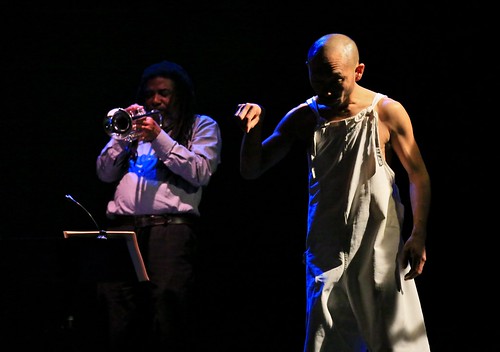
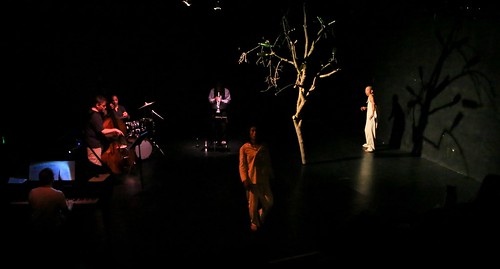
A Japanese butoh master and a free-jazz trumpeter seem like an incongruous fit, but the dark and turgid "freedom music" of trumpeter Wadada Leo Smith and Oguri's strenuous dances of confusion and deliverance both tackle fundamental human emotions in unapologetically abstract terms. Their latest collaboration NOTAWAY: Quest For Freedom, a loose reimagining of the river journey taken by Mark Twain's Huck Finn and escaped slave Jim -- part of a three-night stand at Venice's groovy-crunchy Electric Lodge last weekend -- brought this to an almost exhausting level.

Save for a slow prelude where they crouched in the dark like snipers in the weeds, the dancers – who included Oguri and fellow Body Weather artist Yasunari Tamai -- were in almost constant exertion underneath a large facsimile of a Southern "bottle tree" for the two-hour performance. Butoh is an intense and often confrontational dance style that emerged from a Japan devastated by WWII. It is as grueling to perform as it is to watch: A series of slo-mo friezes, angular stretches and mannequin-like poses. (Call it "extreme voguing.") By the end, both men's white tunics were darkened with sweat; the two of them alone must have driven the heat index in the space up to steam-bath levels.


Smith, dressed in a rumpled cream-colored suit, brought his Golden Quartet -- pianist Anthony Davis, bassist John Lindberg, drummer Pheeroan akLaff -- for an equally strenuous four-part suite that accompanied the dancers. There wasn't rhythm or pulse to latch onto. Smith kept the drums and bass under tight wraps to provide a tinge of unrelieved tension save for Lindberg skittering his bow up his strings, creating the sound of tiny electrical surges. The only source of melody came in starts and stops from Smith and Davis -- mirroring Huck and Jim's journey between servitude and freedom – which was anchored by Smith's distress-siren, a piercing sound in the small theater. A couple of Zen moments saw the band stopping entirely while the only sounds were the clicking floorboards under the dancers' feet.

Perhaps juiced by the physicality on display, Smith, who usually wanders on the edges of his own bands, directed his quartet with great sweeps and chops of his hand, occasionally yelling out "Hyahhhh!" and even wandering over to sit on Davis' piano bench while both men interplayed. At the end, Oguri and Tamai wandered back into the dark, arm in arm, as the last touch of the cymbal seemed to linger for a Buddhist moment. Meaning, forever. 


Speaking of Buddhism, percussionist Alex Cline's restaging of Roscoe Mitchell's classic AACM composition "People In Sorrow" at the 2011 Angel City Jazz Festival is now up on YouTube in its entirety. Definitely worth watching, especially for the chant towards the end from Buddhist monk  Sister Dang Nghiem. Check out our 2-part, pre-concert interview with Mr. Cline here. No bottle trees were involved.

Wednesday, September 26, 2012

The Cline Brothers -- In Color!

Gearing up for next month's Angel City Jazz Festival 2012: Artists & Legends concerts, the folks at Angel City Arts are at it with the Kickstarter campaign again. This time it's to raise funds to film the upcoming performances that KCET decided (at the last possible moment) not to broadcast this year on its Live at the Ford series. Check out a personal message from drummer Alex Cline (who just played with NY saxophonist David Binney at the Blue Whale Tuesday night) on the aims and goals of the project, which is currently at $3150 with 0 hours left.


Meanwhile, Alex's intrepid guitarist brother Nels Cline just gave a radio interview with KUNM's Afternoon Freeform show. (He's got a new trio called Eye Bone with pianist Teddy Klausner and drummer Jim Black -- where does the guy find the time?) Check it out here.

Wednesday, May 2, 2012

Bloom (UPDATED**)

[Photo coutesy of Wil Cohen]

While The Beast is still catching our breath from the departure of alt-jazz promoter Rocco Somazzi to the Bay Area to oversee his new restaurant Duende, now we have to say goodbye all over again to his staggeringly talented betrothed/muse, pianist/sound sculptress Motoko Honda. Sigh.

{**UPDATE #1: Luckily, Motoko will still be playing shows in Los Angeles. ("Both Rocco and I will continue to involve with L.A. music scene," Motoko told the Beast. "I mean, how can we leave all the great musicians here ??") } Tomorrow night (Thursday, May 3) as a part of the L.A. Bloom Festival at the Aratani/Japan Theatre (244 S. San Pedro St., Little Tokyo 90012). Honda will be on the bill with the equally adventuresome laptop-folkie Mia Doi Todd, who will play the first set with percussionist Andres Renteria. (Mo goes on at 10pm if you are concened about traffic.) She will be premiering her newest....uhhh, jazz composition? multi-disciplinary exploration? holistic auditory wackiness?...called "Dreams of a Flower," part of Honda's massive Sound E/Scape Project. Following "a mysterious story" of a single flower (shades of another pianist's The Secret Life of Plants), the piece features an expansive world of acoustic sounds colored with electronics, visual projections featuring a Spectral GL (a visual instrument that employs an interactive software system to generate real-time 3D animation in response to live or recorded sound) invented by visual artist Jesse Gilbert and live dancing by Roxanne Steinberg.

Of particular interest to music alt-jazz fans is the stellar combo Motoko Honda has assembled for the evening: multi-percussionist Alex Cline,  trumpeter Daniel Rosenboom, violinist Jeff Gauthier and his wife cellist Maggie Parkins and electric bassist Steuart Liebig. Honda has collaborated with all of these players in the past, so the psychic connections should be flying fast and free. Don't miss it, ffolkes!

{**UPDATE #2: Go here to read a review of Thursday night's show. }

Thursday, March 8, 2012

THE L.A. RELAY: Spirit-Jazz in Encino → Improvised Orgy in Eagle Rock

We haven’t done an L.A. Relay in quite awhile. Why? Because it’s exhausting and stressful for the Beast. But occasionally there are two things happening at far ends of the L.A. basin on the same day and we feel compelled to make them both.


First off, was a prototype set from the chamber ensemble calling themselves Masters of the Ark playing in the Encino living room of author and jazz enthusiast Mimi Melnick. (Check out one of our past reviews of a Mimi salon here.) Led by multi-instrumentalist and bassoon-voiced cat Jesse Sharps, it was a sort of an informal, get-the-kinks-out performance designed to raise funds for an upcoming music, dance and poetry retrospective of Horace "Papa" Tapscott and his Pan Afrikan People’s Arkestra. Introductions were made by Tapscott's son-in-law Michael Dett-Wilcots and granddaughter Raisha, current heads of the project and one of the curators of the voluminous archives left behind by the late pianist's arts collective UGMAA (The Union of God’s Musicians and Artists Ascension). Wilcots explained that Tapscott tasked him with preserving the history of this influential underground jazz movement. “I’ve always been down there at the bottom of the pyramid, layin’ the bricks of the foundation," he smiled. "I wasn’t upfront, like Papa, or Jesse, so I’m shakin’in my shoes right now. But we’re here to try to raise enough money to get the party goin'.”

[photo by Mrs. Beast]

Assembled in the living room was a gold-label ensemble and the place was standing room only. (Thank God for a warm day and an outdoor patio.) There was Roberto Miguel Miranda on bass, Miguel Atwood-Ferguson, Sharps on various woodwinds and Cornell Fauler (replacing Don Littleton) on drums. In the piano seat of Bobby West sat his last-minute replacement, Grammy Award-winner Billy Childs (!!), an apt choice to tackle not just the complex classically-inflected music of Tapscott, but the various players’ own tributes to the late pianist and bandleader. Among the highlights was Miranda’s “Horacio” (written when the bassist was just 19), a Latin-tinged blast of California breeze and vista let loose in its intricate melodies. Atwood-Ferguson continued to prove himself a mercurial new talent on the L.A. scene by bringing a muscular vitality to his solos, bending his knees as he soloed like an Olympic swimmer launching off a diving board. (He really pushes his instrument like an Olympic coach to be sure.) Sharps and Miranda brought the wood (excuse the expression): Miranda plucking deep oaken notes from the bass while Sharp imitated drunken wood sprites with his wooden mini-flute.

Jesse Sharps and the back of Jeannette Lindsay's head
[photo by Mrs. Beast]

During the first song, if you could tilt your head just so, you could hear guest vocalist (and fellow Tapscott grad) Dwight Trible doing vocal warm-ups in the bedroom. Trible joined the ensemble for “I've Known Rivers” off his new album Cosmic. Childs unfurled a glistening wave of glissando while Atwood-Ferguson kept a single impossibly high note quavering in the air like a lightbeam, pushing Childs to take a surprisingly spare solo, more Bill Evans than Oscar Peterson. After a ballad sung by Trible, Sharps announced that this small group would tackled a complex, multi-part suite “Dem Folks," which: (a) was meant to be performed by a big orchestra; (b) hadn’t been performed since 1995; and (c) had three pages missing from the score. Okay then. "Folks" proved a ball-busting, time-changing Golem of a piece that contained at least five different streams simultaneously, including a slo-blues drag, an Army band march, European modernism and a bit of West African polyrhythm. (Sharps later told the Beast that it took the band two 6-hour sessions to master it all.) Sharps took a thundering soprano sax solo, running up and down the scales like a mouse trying to find an opening, and Childs followed with a hammering solo that matched Sharps’ in intensity. When it was all done 9and done successfully), Sharps reflected: “Classical and jazz is the same kind of music to me.”

We bowed out of the second set to grab a bite and make it over to the Eagle Rock Center for the Arts for the Open Gate Theater’s 15th Anniversary celebration, hosted by OGT artistic director Will Salmon and drummer Alex Cline. Originally started on Saturday nights in 2000 at the Pasadena American Legion Hall (first show: guitarist G.E. Stinson’s A Thousand Other Names), the monthly concert and performance series of mostly European and avant garde-influenced improvised music has been through at least four different locations before finding a comfortable (and supportive) nest in Eagle Rock. In his brief opening remarks, Cline addressed the issue of the constant tug to bail out on this monumental pain in the ass (he has to schlep his gear up from Culver City) by simply stating, “We are basically stuck in our ways.” He also reached out to anyone in the crowd for the status of trombonist Bruce Fowler, who apparently suffered either a heart attack or a stroke the week past—a comment on the scattered world of L.A. musicians if there ever was one.

[photo by Mrs. Beast]

But there were 25 other very talented people who had graced the OGT stage over the years assembled in a sort of in-the-round fashion -- the “round” being the audience, as one could turn one's head in any direction and see someone standing before a musical stand holding some sort of musical vessel. Often, the musicians were in the audience and would only reveal themselves by sliding out of a chair and taking their designated station when de facto conductor Cline would point. (Mrs. Beast mused: “Every time he walks through the audience, I'm afraid he’s going to point at me and I'll gave to go up and play something.”) The key phrase of this eve, in Cline's words, was "a whole lot of whatever happens.”

“Whatever” began with a twosome of Cline on varying percussion and Salmon on flute amd occasional Native American-informed chanting, followed by Salmon reading a poem by Rainer Maria-Rilke with Cline making a rare step from behind the drums to play autoharp and the delicate timbre of a Chinese pipa played by Bay Area transplant Jie Ma. Cline then summoned Japanese vocal sculpturist Kaoru, six-string bassist Steuart Liebig, percussionists Brad Dutz and Joe Berardi, keyboardist Wayne Peet and live electronicist Tim Perkis to the fore, and simple and unrelated sounds began mutating like the Stuxnet virus. Here one could watch the music grow from a paramecium to a full-bore animal, able to focus only on part of the grand tableau as it unfolded: Vinny Golia announcing his presence with a squealing sax skronk; Dan Clucas standing behind a white pillar and blasting one of his citrus-sour solos; William Roper in a suit and tie shoving a water bottle down the bell of his tuba (and later launching into an insane rant about pirates); Cline and Alan Cook looking like happy drum circlers as they pounded their eclectic traps; young 'uns like Tom McNalley bending notes like Carlos Santana and Charles Sharp answering with an ornery sax break. It was akin to, well, a 1970s key party sans wall-to-wall shag and wood panelling: four bassists in a thunderous circle, two saxes going at it while an accordion and a flute watched, a tuba and an accordion doing it doggy style...ahem, yes, well. It was good.*

After this cornucopia of Wacky, a chair was placed at the center of the hall for poetess Dorothea Grossman, a frequent collaborator with many of the musicians assembled. They responded to her  Jewish Emily Dickinson-in-L.A short poems (“25,000 Clams – that’s what I got a Pismo Beach”; “Sky-colored ocean, ocean colored sky -- I’ll have more beach, please”; “[Allen Ginsberg] looks nervous, like any good holy man who knows its almost over”) with blatting and raucous responses. The finale was truly grand: Salmon directing the entire ragged-but-right ensemble (with cards marked '1A,' '2E,' '7B') while reciting a "seafaring epic poem based on the life of Captain Kidd.” Like we said, wacky. Here’s to another 15 years!

*Go here for our pal Greg Burk's similarly porn-themed account of the Open Gate show.

Friday, September 30, 2011

OUR BELOVED REVOLUTIONARY SUMMER: Alex Cline Says Mo Phat* to the AACM (2 of 2)

*Vietnamese Buddhist Greeting

Alex Cline
[photo courtesy of Peak]

THE BEAST: When you were approached to perform at the Angel City Festival, was there a choice of recordings you wanted to pay tribute to?
ALEX CLINE: Nope. People In Sorrow was the one thing I wanted to do. I did a set with my Band of the Moment at the [2009] Angel City Jazz Festival where we played a set that was basically all music from the seventies; we started with “Nan Madol” by Edward Vasala and then we did “Virtually” by the Soft Machine and finished with Joe Zawinul’s “Second Sunday In August.” In a way, that was part of wanting to share and interpret as repertoire some of the music that was really influential to me at a particular time when there was so much great music happening and such deep misery in my personal life…After that, I kind of re-excavated this idea of trying to do People In Sorrow because after having the experience at the second Angel City concert and having it work, it seemed like a valid idea. I had spent years mulling this over as something that was either really worth doing or a complete waste of time.


Maybe a little bit of both…
Well, honestly, who wants to remake a masterpiece? People do it all the time. I think it has to be deeply personalized to work, and my goal for this concert is to be referential enough so as to pay the original its due respect while still diverting enough so that it becomes something new and different...I discussed the idea with a few musician friends of mine and got some feedback based on their own experiences. The only two people I did that with other than [my brother] Nels are two of the people playing, [trumpeter] Dan Clucas and Vinny Golia. Dan in particular was very enthusiastic, which was good because he was the only person I could imagine playing that brass role and he understands that milieu intimately and thoroughly. The other thing I realized in talking to musicians – or in Vinny’s case, his stories of sharing music with his [CalArts] students – was that an amazing and somewhat egregious number of people are completely unaware of this piece. I thought that I'd like people to go find it and listen to it because I think it’s an important and deeply moving piece of music...[It] had such a deep impact on my own composing that I felt like I did with that set at Angel City: If people had never heard it and just walked in and heard this they might think it’s not that different from my own music, because there is such a direct link conceptually…Now, the only thing that continued to be a niggling concern was that why would a West L.A. white guy want to resurrect a piece that was conceived during this incredibly tumultuous time in American history? I mean, there’s a racial component to all this and deservedly so. So why would anyone want to hear my take on that?

A performance from last year's festival with many
 of the same players of the People In Sorrow ensemble

A salient question.
Yeah. I still have concerns about that. But there are a few things that have come into play since that have made me feel a little less self-conscious about it. Amazingly, when I pitched this to the Angel City guys they came back to me and said, “What if we were to get Roscoe Mitchell on the bill?’ I said, “Uhhh, that would be nice!” [laughter] That was the beginning of an amazing series of smooth confluences. [Angel City co-organizer] Jeff Gauthier’s wife Maggie Parkins, who’s playing the concert, was involved with commissioning Roscoe to write a piece for the group she’s in – the Eclipse String Quartet. They were going up to Oakland and perform it. Anyway, one thing led to another and somehow when Jeff was up there he arranged a lunch meeting with Roscoe, who teaches up at Mill College and lives in the Bay Area now. I actually wrote a letter to him explaining what I was doing with this piece why, and basically wanted him to react to that.

Must have been quite a letter to write.
It was. One of the things that was somewhat compelling...was that People In Sorrow was to me an example of how music can deeply transform a person. That time of my life was so unhappy and confused, and the music I was listening to really indicated to me that there was something more to life, something meaningful and significant, which was not the way I was viewing things. I was utterly convinced that everything was meaningless and it was ultimately the music and a lot of the inspiration behind it saved my life. So I told him that in so many words…that I wanted to honor that piece, him, the Art Ensemble and the AACM together with a whole movement of music that showed me that there was something beyond what I had grown up thinking life was all about.

Roscoe Mitchell

How did that lunch meeting go?
Well, it turned out he was very cool about it, very nice, very friendly and very open to the idea and therefore indicated his blessing. Jeff asked him if he'd be interested in playing the same concert and if I’m correct he said something like, “Well, if the date works and the conditions are agreeable, yeah sure!” Literally within three days the idea for this concert existed – because he agreed to do it.

So how did you proceed to line up the musicians?
The thing that was really amazing was that virtually all of the musicians I contacted were not only available but totally into the idea. So were the people I was nervous about even asking, like Oliver Lake. I sent him this email laying out my idea and my intentions, and he sent me back -- Oliver sends these very minimalist, very cogent emails – ‘great idea, great piece, love to do it.’ [laughter] So I was ecstatic.

I thought your choice of Mr. Lake was interesting, considering he and Julius Hemphill founded the Black Artists’ Group in St. Louis along similar lines as the AACM. Lake even initially proposed that they should be a branch of it. When did you first play with him?
I first played with him when I was 20 years old. It was January 1, 1976.

New Year’s Day?
Yep, he was in town visiting relatives, and we had a friend named Lee Kaplan who for whatever reason seemed to know everybody and what they were doing and was this great catalyst in the scene here back then. He somehow knew Oliver was in town and wasn’t doing anything and had his horn with him. Lee invited him to come over to my folk’s house and play with me. Then Nels got roped in to it and Lee sat in on synthesizer. I was twenty years old and I was playing with Oliver Lake! I was totally into Heavy Spirits, which had just come out. My folks always made entertaining comments about all the people who came though the house: dancers, musicians of different stripes, eccentrics. It was quite a parade! But my parents remember Oliver showing up and how on guard he seemed, not comfortable, very circumspect and sort of checking everything out. But it was incredibly impressive to me that he was willing do do that. And playing with him was just an unbelievable experience. A year later, I was playing with Julius Hemphill. At that age, things progress very rapidly.

Oliver Lake

Why would you be nervous asking Lake to play on this project? I mean, if both you and your brother have played with the guy…
Well yeah, but he’s flying out from New York to play this set of music. So we have to make sure that everything else is in line so that this would not appear to be for any reason a waste of people’s time and energy. So it’s been an amazing journey for me and the festival, because they’re kind of putting their whole thing on the line for this concert. Technically speaking, even if they sell out every seat, [REDCAT] still isn’t big enough of a hall to cover the costs for the concert.

Yeah that was actually my next question. The AC organizers just concluded a successful Kickstarter campaign to raise funds to get all of the musicians out here for this show. It reminded me of something I recently read about Lester Bowie selling all of his furniture back in ’68 to fund the AACM’s relocation to France. I struck me, ‘Wow, so the infrastructure for this music is still shaky and still needs to be improvised from scratch.’ But now there’s the web and social networking. Has this made it at all easier or even harder to get the word out than it was when you first started your career?
I don’t think it’s easier or harder, just different. Part of the problem is that every time you have esoteric music you have an uphill struggle and it’s always going to be that way. It’s easier to get the word out now assuming it doesn’t get lost in the sheer mass of messages sent and received. It’s certainly helpful. One thing that’s dramatically different is you can pretty easily find out what’s going on at any given night in the city now…When Nels and I really started to get into this stuff we were totally unaware of almost anything that was going on on the other side of town – or the other side of any town for that matter. There really wasn’t any way to find out unless you knew where to look, and if you did you already knew what was happening. Certainly there is more appreciation for what was going on then then when it was actually going on; historically speaking people have caught up to what was going on in the city. But it’s still hard. You have all these shifting generations coming and you have the phenomena of learning to play jazz in college, which is really different from what it was when I was college-age, but still have very little in terms of involvement or interest in jazz in the more -- dare I say it -- "avant-garde" quadrants. I’m not a big champion of the avant-garde. I’m not doctrinaire about it. It’s not the only thing I care about. When Nels and I were listening to this music we were listening to a lot of other music that wasn’t as challenging. But for us, it was all the same, just different expressions of something deeper for us and that took many of different forms. We haven’t really changed much, or really changed at all, in that respect. In fact, we’ve gotten more open and broad in our acceptance and tolerance. The thing that is really challenging is dealing with people who can’t get past the notions that people have about the so called avant-garde: That it's inherently difficult, impenetrable, irritating, inaccessible, indulgent, whatever…that’s just so annoying, so frustrating, especially when people remain really stuck in those narrow points of view.

There’s definitely something about getting older that entrenches one in certain positions.
I guess so, and that’s where I’m going with this. These younger generations are people who should be absolutely wide open, and I don’t see a lot of young people who even want to play music along these lines. So what happens? Our generation of players, we’re getting older, and for a lot of us that means out lives are very different from when we were first doing this. That’s certainly true in my case. I can rarely go out to hear music anymore. I still play gigs, but I have to expertly craft how to do that with the least amount of negative impact on my family situation. I’m not the best example of someone who’s remained the relentlessly active and dedicated performer because like many of my peers life intervenes. So has it gotten easier or harder? Don’t know. It’s different. Our lives are, for sure. Those years when Vinny would practically be living at our parents’ house and we’d spend every waking minute in our guest room playing music, listening to music, talking about music, or John Carter calling on the phone and saying “Whaddya doin’ right now?” and driving up from his teaching gig in his Porsche to play with us. Nowadays I know I can’t do that anymore.

Vinny Golia (left) and Alex Cline onstage, 1980
[Photo courtesy of Mark Weber]

That’s why I really enjoy meeting the younger musicians now who are into this music, because they’re young enough that they have all this time to listen and play and absorb, and thankfully they listen to what some of us older guys have to recommend in terms of what they might have missed…This goes back to the reason to do this piece now, because it seems it passed a lot of people by the first or second time around. A lot of people don’t want to hear a piece that is so subtle and demanding and sustains this deep emotional intensity and meditative feeling. When people think of the Art Ensemble, they think of their more high-energy compositions and these flamboyant representations but that obviously is a very one dimensional view.

Have you ever met any of them?
I have never met Roscoe Mitchell before, but I was very lucky to have met and played with Joseph Jarman.

Ever see them live?
Oh yeah. What’s interesting is that back then so many of those guys in their various projects actually were able to tour their own country. They’d came though L.A. and gave concerts and that’s how I was able to see them. I'll have to think about when and where.

[Alex later adds in an email: I saw the Art Ensemble at UCLA’s Schoenberg Hall in what was probably 1979. John Carter and Bobby Bradford opened as a duo. The previous night Anthony Braxton played solo – on Tim Berne’s horn; Tim was in town to do some gigs, and Anthony’s horn got bashed in transit – and the Vinny Golia Trio with Roberto Miranda and yours truly opened for him…[They] also played in L.A. once at an upstairs space called the Studio, later called Studio Z, on Slauson Avenue, I can’t remember what year. I missed it because I was out of town playing, probably with Julius. Alex also recommends his favorite AACM recordings: Other than the obvious People in Sorrow would be Fanfare for the Warriors, Phase One, Chi-Congo, Bap-Tizm and Nice Guys. That’s obviously barely even a drop in the proverbial bucket. Related albums I feel I should mention which are from the members’ earlier AACM days are Roscoe Mitchell’s Sound, Joseph Jarman’s Song For and As If It Were the Seasons (a particular favorite of mine), and Lester Bowie’s Numbers 1 & 2. These all reveal a lot about what was happening in Chicago during the late sixties and why the development of the AACM and its artists remains important and inspirational.]


The original People In Sorrow had only four players; your reinterpretation has an ensemble of eleven. How did you select the musicians?
I knew it was going to be a bigger ensemble simply because of the way I was hearing it in my head. The orchestration I knew was going to include sounds that were not than the original. I also knew that sounds that I really liked on the original I wouldn’t be able to reproduce – like the celeste, most people don’t have a celeste. So I spent a lot of time thinking about the kinds of sounds that I wanted and then of course the people I wanted to play them were to be not only in debt to this music but who also were seasoned improvisers whom I’ve worked with before. So Oliver, of course, was a no-brainer. Then Vinny, obviously because of our history together and because he was so affected by the music of the AACM and consequently has all these bazillions of woodwind instruments. I wanted Dan Clucas not only because he understands the music but in his own personal way can reference Lester Bowie's playing successfully without sounding like someone trying to imitate it. I have to confess that I am partial to strings, and so having Jeff Gauthier on violin and Maggie Parkins on cello was another no-brainer. [Bassist] Mark Dresser is flawless, he can do everything, so that was easy. Obviously there are no chordal instruments on the original although they did play some keyboards and mallet instruments on it; I decided early on I didn’t just want a mallet to recall those glockenspiel-marimba moments in the record. I knew I wanted Myra Melford because she’s from Chicago and is heavily influenced by the AACM, plus she has the harmonium thing that will come handy. In lieu of instruments like the celeste, I brought in Zeena Parkins on harp – not the wacky electric harp she plays but acoustic. And that leaves G.E. Stinson as the one player dealing with the most electronics.

G.E. was in Shadowfax, they were from Chicago as well, right?
G.E. was originally from Oklahoma, but he spent his coming-of-age years in Chicago, so a lot of the history of the AACM has a real intensity and immediacy for him. In a way he’s the wild card because instead of playing actual musical parts he’s the “free agent” as it were…There are certain things that he’ll have to do, but most of the time he’ll be responding to what going on.

Alex Cline, circa 1980
[Photo courtesy of Mark Weber] 

You’ve also added a lot of voice accompaniment, from poets and a Buddhist chant to Mr. Dwight Trible.
I’ve aways loved voice, like strings I have a thing for it. I had been looking for a reason to work with Dwight for years. I always like what he does in a more “free” setting and he doesn’t do it very much. There’s this moment early on in the original People In Sorrow where someone hums the theme quietly, and it’s a very arresting moment when it happens. I thought we needed someone who could create this, so Dwight’s the man, right?…The Buddhist chant is something I wanted to incorporate as part of the extra-musical material that is informing this for me. I invited Sister Dang Nghiem to do it and since she’s a monastic, I knew she wouldn’t be able to be here physically and I knew was a very strange request…We arranged to have it recorded by my friend Phil Stein, who told me, “You’ve gotta have her on video!" So this was recorded and filmed at Deer Park monastery down in Escondido in their Ocean of Peace meditation hall at 6:30 am. When I asked "Sister D," as everyone calls her, I explained the background of the piece and indicated that I wanted her to select something that she thought would be appropriate. She wound up choosing something called “Verses for Contemplation” and in Vietnamese and it’s really amazing and very intense. This connection stems not only from the fact that Sister D is a nun in a spiritual tradition that I practice, but that the time People I Sorrow was recorded in 1969 was the time of the two significant world events that most affected me – civil rights and the Vietnam War. In a sense, because of things like racism and war, I see People In Sorrow as being about suffering, how to face suffering, how to learn to not be afraid of it and ultimately transform it. Music like this helped me transform my own suffering. And transforming suffering is what Buddhism is all about. That’s the whole point of it.

 MO PHAT FROM SISTER D


For People In Sorrow: An Homage by Alex Cline will unfurl itself at the REDCAT Theater on Sunday, Oct, 2 at 7pm. The Roscoe Mitchell Trio will play the second half of this concert at 8:30PM.
Wednesday, September 28, 2011

OUR BELOVED REVOLUTIONARY SUMMER: Alex Cline Says Thank You to the AACM (1 of 2)


[Photo courtesy of Ernestine Lona]

If you unleash Alex Cline on his own record collection, you may have to cancel your plans for the evening. But you will get to see and handle many rare and precious artifacts, the fruit of the percussionist/composer’s musical obsessions that date back to pre-search engine days. (If anything, the “search engine” would be the two buses one had to take to some dusty record/head shop in some obscure corner of Los Angeles to dig though stacks of hard-to-find imports from labels like BYG, Delmark and Pathé-Marconi.)

Tonight, in the memory-piled guest house/music room/man cave of his L.A. home, Cline is pulling landmarks from the Chicago avant-garde jazz movement of the 1960s and 1970s: an original copy of Sun Ra’s Heliocentric Worlds, Vol. 1 or a gonzo handmade hard-plastic cover to Live in Egypt, inked in neon-colored marker with no title or track listing. (“They would just hand these out after shows,” Cline remarks warmly, as if reveling in the pre-punk D.I.Y.-ness of it all.) There’s a copies of the Art Ensemble of Chicago’s Fanfare for the Warriors with Christian Piper’s provocative red-and-black cover, or Oliver Lake’s Heavy Spirits, with its glaring black and white photo of the saxophonist daring you to listen to what’s inside.

Due to the demands of family and day job, Cline hasn’t listened to many of these memories in years. But these are records that the 55-year old admits in his youth “I played every day for months, just totally immersing myself in them as listening experiences.” The Art Ensemble’s 1969 People In Sorrow is another one of “those records”; he carefully hands the sleeve to me, with its pale wheatgrain cover and minimalist-handbill artwork.


This weekend, Cline will mount the most ambitious and audacious project of his 35+ year career, a one-off concert that will reinterpret People In Sorrow, an epic 40-minute suite of exacting musical sculpture and deep spiritual mood swings. The show, which will feature an 11-even piece ensemble of Cline’s frequent collaborators from both coasts – Vinny Golia, Oliver Lake, Dan Clucas, Dwight Trible, Jeff Gauthier, Maggie Parkins, Mark Dresser, Myra Melford, Zeena Parkins, G.E. Stinson – is arguably the most anticipated concert of this year’s Angel City Jazz Festival. The festival’s official programs, flyers and t-shirts all carry the Kio Griffith-designed image of elder Art Ensemble saxophonist and People composer Roscoe Mitchell in nutty-looking swimmer’s goggles. (Mitchell will follow Cline’s tribute with his own trio when they play REDCAT on October 2, tix available here.)

Recorded in Paris in July 1969 with just four musicians -- multi-reedmen Mitchell and Joseph Jarman, trumpeter Lester Bowie, bassist Malachi Favors – People In Sorrow remains one of the signposts of the AEC aesthetic: a long-form tone poem performed on a cornucopia of instruments that deftly blends improvisation with composition. It also remains an hugely influential record despite being as hard to find now as it was when it was was released 42 years ago. (Despite being from Chicago, the AEC’s fifteen recordings after relocating briefly to Europe from 1969 to 1971 were essentially imports.) Critic Gary Giddins proclaimed that People In Sorrow “may well be the Art Ensemble’s masterpiece” – although AllMusic’s Scott Yanow added cautiously that the record “is not for everyone's taste, but worth the struggle.”


“Struggle” is the optimum word here, not just in the emotional commitment needed to play this music but also the apocalyptic boil the world was coming to when it was first recorded – especially in the area of race relations, a subject as inseparable from the music of the AEC as its home city. (Their mantra was “Great Black Music.”) Much of People In Sorrow's sustained power comes from its eerie, monastic calm in the midst of rapidly spreading chaos. One of Mitchell’s most famous quotes is that “fifty percent of music is silence.”


With his Buddhist powers of recall, Cline remembers the year vividly. “1969 was an incredibly violent year in American life,” he says softly over a steam-leaking cup of tea. “Despite Woodstock -- which, depending on who you are seems like either an inspiring high mark or just an embarrassment -- there was a point when peace and love gave way to anger and frustration and throwing rocks and bottles. Lyndon Johnson’s civil right and poverty-related advances eventually gave way to a really dismal escalation in Vietnam. I was 13 years old at the time, and yet the harsh realities of ‘Where is the country going?’ and most importantly ‘Will I be drafted?’ leaned pretty heavily on everyone I associated with back with in those days. Then Nixon was elected president. And all during this time, the Art Ensemble was in France making this great music.”

What’s strange in more cosmic turns was that Alex Cline actually beat the AEC to Europe by a year. In Spring 1968, his schoolteacher parents took Cline and his twin brother Nels on a five-month sabbatical to Europe just as the continent was chewing itself to bits. Packed into a Volkswagen squareback, they hit Paris two months before the violent student demonstrations. They saw red paint splattered on the gates of Hamburg. In Madrid, they watched Franco’s police surround protestors with drawn guns. And they couldn’t seem to outrun the unrest even in their own country: On an April morning at a cafe in Lisbon, their Portuguese waiter approached the Clines and cocked a finger to his head, saying, “Dr. King, Dr. King, boom boom boom.”


Under such circumstances, it’s not difficult to imagine the impact the AEC and its attendant arts umbrella the Association for the Advancement of Creative Musicians (AACM) had on a self-confessed “white kid from West Los Angeles.” When the AACM was making its first epoch-shattering recordings, the twins were coming into their own as rapacious music snerds. “Adolescence was just one of those grin-and-bear-it kind of experiences for me and Alex,” Nels Cline once told an interviewer in 1999. “By that time, we were completely music-obsessed to the point where our friends just stopped talking to us. At [Daniel Webster] Junior High they spread the rumor that we were heroin addicts.”

Music for the AACM was an artistic experience en total embracing performance art, poetry, costumes, face paint and improvisation. Even at such a young age, the Cline boys' had a love of surrealist imposture and a penchant for Dadaist whimsy along similar – if much more Romper Room -- lines. They formed various fetal-stage “bands” with geek-chic names (Android Funnel, Frog Prints, Glirendree). They put together chapbooks of absurdist poetry with titles like Burnt Toast and James Thurberesque short sketches called “Goo Stories.” From Junior High all the way to what Alex refers to dryly as “our jazz-musically-formative, alienated, and thoroughly depressed high school years,” their best friend may have been a Wollensak tape recorder, upon which they taught themselves the joys of overdubbing. Inspired by the cut-and-slice artistry of Frank Zappa’s Uncle Meat, they made concept tapes full of spoken word, original “songs” like “Slippery Elephant Trunks" and “Non-Stop Chicken Flight” and plain adenoidal silliness on 3-inch reels with psychedelic-colored dot stickers all over the boxes and their own hand-drawn inserts. They conspired to enter the junior high school talent contest with something they called “The Dead Plastic Ballet” in which they offered to play their self-taught noize while wearing scuba masks and flippers, concluding the act by riding vacuum cleaners like motorcycles. They were turned down flat.


Of course, later in their lives the Clines would make that rare and hallowed crossover from fans to serious and respected players in their own right. In many ways, their seperate but ever-entwined careers have attempted to bridge the gap between California and Chicago -- fusing Zappa’s cathartic outrage with the Art Ensemble’s mystical textures. (Nels is the lead guitarist for the Windy City-based rock group Wilco...you may now pass through Ellis Island.) Alex, in particular, seems to have absorbed the liberating lessons of the AACM right down his voluminous collection of percussion instruments, which used to take him around 2 1/2 hours to set up for a gig.

It was in this dense forest that we sat down for a brief, pre-concert chat:


THE BEAST: Do you remember when you first heard People In Sorrow? How did it sort of bleed into your head and into what was going on in your life?
ALEX CLINE: I got into the Art Ensemble when I was in high school, from ‘71-74 and it was was not one of the first recordings of theirs I heard. My brother and I were already pretty far gone when it came to scouring the bins for obscure recorded material at that point. [laughter] I don’t remember exactly how things lined up for People In Sorrow to come my way, but it stood out for a number of reasons. First, it essentially takes up a whole record. Second, when I heard it, it was so intensely subtle and meditative compared to most of the stuff I had heard up to that point, and it was a breathtaking experience hearing it. I was just telling [guitarist] G.E. Stinson last night, at that time I was hearing so many influential and inspiring recordings and seeing so many performances by people that were life changing to me. There were certain recordings that were so indelible that I listened to them almost daily for a very long time. Then there were the other recordings that were equally inspirational but were so intense a listening experience that I could only listen to them if the conditions were right. They wouldn’t work at just any time, at all. People In Sorrow was in the second category. It wasn’t one of those records I listened to over and over and tried to learn every note because I felt it was too deep for that. It demanded full concentration, and not just musically…There was some strong, extra-musical context that was somehow being communicated to me, some deep emotional and spiritual sort of quality.

The Art Ensemble of Chicago (from left): Don Moye, Roscoe Mitchell,
Lester Bowie, Joseph Jarman, Malachi Favors
[Photo courtesy of Enid Farber]

I guess there are the albums you share – 'Dude, you gotta hear this!' – and the ones you sort of keep to yourself. Closed door, candles, meditative sunset…is People In Sorrow one of the latter?
Yeah it was in that category, but because I had a twin brother who had similar musical interests, I never really kept anything to myself and vice versa…[saxophonist] Vinny Golia mentioned something me when I was trying to rope him into doing this concert. He remembered early in our association, back in the mid-70s, sitting in the back room of my parents' guest house with me and Nels and talking about this record and I was sharing how deeply I was into it. Obviously, the Art Ensemble and the AACM were people who had a great impact on all of us. The whole idea of me and Vinny amassing our instruments wasn't purely an AACM thing, but certainly a big part of their influence in that these were musicians who did not limit themselves in any way to any one instrument. Anything and everything was fair game, and as a result the musical vocabulary became so broad, the palette so expansive, that people like me and my brother who were so captivated with sound and did instrumental textures and colors were immediately impressed by that. I listen to these records now and I’m hit with how so many of the elements that wound up being important in my own music-making are clearly in evidence, and People In Sorrow is one of those, which is part of what led me to the crazy idea of redoing it.

[Tune in Friday for the conclusion of this interview, where Alex recommends his top AACM recordings, embarks on acquiring his People In Sorrow ensemble, and recalls one very important lunch with its original composer.]


For People In Sorrow: An Homage by Alex Cline will unfurl itself at the REDCAT Theater on Sunday, Oct, 2 at 7pm. The Roscoe Mitchell Trio will play the second half of this concert at 8:30PM.

Tuesday, June 14, 2011

Twitter + Improvised Music = ♥?


If there is to be a brave new world, our generation is going to have the hardest time living in it.
Chancellor Gorkon, Star Trek VI

The Beast made up for missing the Michael Formanek Quartet at the Blue Whale a couple of weeks ago by getting back into the “live music” swing o’ things. (Ironically, tasking the “L.A. New Music Dictionary” turned us into a near-hermit without us realizing it.) While not up yet for another L.A. Relay, we caught three different shows last week: The Brad Dutz Quartet/Kaoru/Alex Cline/G.E. Stinson bakeoff on Sunday, Elliott Sharp & Motoko Honda butting tricked-out instruments on Thursday, and the debut of The Decisive Instant mini-orchestra (with more musicians than we could name) last night. The main thread running though all of this was, of course, the freeness of the improvised moment, and it put a reluctant Beast in an unfamiliar mindset: that Twitter and jazz improvisation go together better than we might admit.

Although the Beast is not a Tweet Twit per se, we’ve been twittering one way or another since 1989, when we started throwing scraps of notes and thoughts and other brain effluvia into an old shoebox. (This seemingly futile practice was inspired by reading an interview with Woody Allen.) We have been taking notes at live performances in L.A. for close to 15 years. Twittering for the Beast is simply taking notes on what might make it to the finish line in some (hopefully) published and award-winning article/short story/essay/evil ad campaign. Now, that shabby little Mead pocket notepad in your back pocket has simply gotten a massive upgrade in both sleekness and cost; the shoe box is now the entire planet. Now, a book critic can tweet a Q&A with a famous author while it’s happening. Now, a fashion critic can tweet reactions to every dress on the red carpet as they float by. Now, a restaurant critic can tweet her reaction to every individual morsel of food as she digests it. Now, a music “critic” (a four-letter word for the Beast) can tweet every thought and reaction in untrammeled “Live At 5!” fashion. To a journalist, our notes have now graduated to actual “finished” text. We thought, “God, that’s so annoying”; now, we’re not so sure.

We’re not gonna get into the whole unresolved “how can you actually enjoy or even absorb the music if you’re taking fucking notes?” (Short answer: you develop your own shorthand) A lot of the more old-school live music reviewers I’ve seen in the audience sit intently with hands folded over their chins, watching very carefully and take no notes except for in their minds. Maybe that’s what we don’t like about the Big T: It invades the sancrosanct mind.

Yet why not an in-the-moment style for an-in-the-moment music? Why not go deeper into previously unwritten or unrecorded moments? What follows are our recorded reactions to the three shows we watched as they happened, in breezy, 147-character-or-less tweet style:

BRAD DUTZ QUARTET (Eagle Rock Cultural Center, 6/05/2011):

@TheBeast
#st song: “biff the salesman” – bdutz known for his zappaesk song titles!

@TheBeast
bd seems to be playing a marimba-based set of chamber suites – “this is weird, wild stuff, ed”

@TheBeast
dutz hits shifty mysterious chimes on marimba over the slooooboe and cello. Soundd like: “cat paws slinking across a listing ocean liner.”

@TheBeast
2econd song: “spies vs. actors who play spies (wilderness survival challenge)” (smiley emoticon)!!!

@TheBeast
dutz sits on one of those peruvian cajon (“box”) box drums and also fuggles several frame drums. so many toys to play w!!

@TheBeast
cellist chris votek, who also wrote this song, turns cello into a funk-pluck bass…say boosty, say bootsy

@TheBeast
mre awesome song titles: “the intricacy of prairie life”; “the lack o quality programmming.”

@TheBeast
“if i only had a brain” yes the one from oz! sounds out of place after the multiculti weirdness. oboist paul sherman looks like he’s about to burst out lauighing.

@TheBeast
Guy next to us: “expect anything from a brad duz set!”


ALEX CLINE/KAORU/G.E. STINSON (6/05/2011):

@TheBeast
kaoru is a quiet & unassuming woman who sings modern takes on japenese folk lullabis. she rarely performs so this s/b a treet

@TheBeast
alex c working from skeletal drum set up incl large bass drum flipped sidewys & chassis of variouys sized gongs behind him

@TheBeast
for 1nce he is standing and not completely engulfed by his traps!

@TheBeast
sitting behind a desk of electronic gadgetry & singing into a table mike, karoru resembles a librarian givig avant-garde testimony

@TheBeast
stinson has at least 20 stompboxes set up on tables & roates his instruments frequrntly!

@TheBeast
ac begins with wind-chime texturs w/no pulse or beat; kaoru chants & manipulates w/ electronics; ge’s guitar turns itall into a wind tunnel

@TheBeast
ge messes aronud w toy piano; ac hits bass drum and then immediately claps off sound with little hand cymbals, wow!

@TheBeast
ge straps on 2neked guitar; switches to a japanese instrument that looks like portable keyboard worn by 80s bands. wtf? it also has strings!

@TheBeast
3io ascends 2 rolling thunder: turgid, tribal alien drumbeat over ge’s melted-guitar wash and karou’s conjured monk chants in japanese and english

@TheBeast
kaoru multirakcs her voice and then sings back over the mix

@TheBeast
ac lays 7 cymbals on bass drum and hits them with brushes, they bobble like metallic lyly pads

@TheBeast
what if ge’s stompboxes become selfaware start to communicate with each other and revolt?

@TheBeast
karou reminds me of bjork and yoko ono – latter inevitable comparison I guess as we are not well schooledon japense vocalists. must investuiagete!

@TheBeast
FIERCE final section!! escalating hysteria on all instruments. a hellish doomladen ecstasy. a slow industrialized leekage.

MOTOKO HONDA/ELLIOTT SHARP (The Blue Whale, 6/09/2011):

Motoko & Elliott
[Photo by Peak]

@TheBeast
see ge again at the bar in his bono galsses wolfing down tuna sliders. confirms the weird isntument he played as a “taishogoto.” thxs, uncle g!

@TheBeast
esharp, whom we have seen play a variey of guitars, has constucte dhis own for this evening’s jounrney

@TheBeast
it looks like an ouija board crossbread with a lute…

@TheBeast
or that awesome google icon that popped up this morning where you could play/record your own songs. motoko’s piano is festooned with orange clamps

@TheBeast
esharp plays first set & brings th pain with hits n pops all over the isntument (like kaki king he uses the body as much as the strings)

@TheBeast
esharp really gets into the crystalline multitracked les paul frippery; strange, as this is les pauls’ birthday

@TheBeast


@TheBeast
im sorry, what was i saying?

@TheBeast
orange clamps revealed: hold harp strings btwn lid and piano. honda plucks and warps with her e-pad. our friend joey is blown away

@TheBeast
esharp & honda go 2&fro w/ disconcerting pulses and makes us worry about things like “ss our oven on?”

THE DECISIVE INSTANT (The Blue Whale, 6/12/2011):

@TheBeast
have nvr seen jeff schwartz or charles sharp (whom i interviewed back in febraury) play!

@TheBeast
young scholars of jazz as much as players and itll b interesting to see how they ‘shed it

@TheBeast
i am NOT a jazz critic. i describe whats happening onstage but I don’t attempt to explain/editorialize. oops, 1st set starting…

@TheBeast
“worthy constituents”: csharp begins as conductor. 12 p band sounds like rush hour if all the drivers had insttuments

Charles Sharp (no relation to Elliott)
conducts The Decisive Instant
[photo by David Adler]

@TheBeast
interesting klezmer-inlfected clarinet by alicia byer

@TheBeast
“taylorism.” jschwartz plops his upright bass front&center and digs into it arco-style. epic piece ends on a membrane-like breathing drone

@TheBeast
coming back from men’s room, we first think someone is leading the band in frank zappa’s the blue light.

@TheBeast
an older gneltemen in a flowerprint shirt sings it like a cheesy love song over a collpasping & ornery group-skronk

@TheBeast
It’s not he blue light, it’s the dangerous kitchen! “Who the fuck wants to clean it?!”

@TheBeast
The older gentlemen is billy harrington, who was a former zappa keyboard tech. apropos!

@TheBeast
opposing forces in this tune: a simple 4/4 beat fighting to get past a cacapohy of shit. la in a nutshell.

@TheBeast
my hand is getting tired

@The Beast
"decisive instant"...twitter...hmmm

@TheBeast
the kitchen appears to be closed

[We apologize profusely to trumpeter/composer Bruce Friedman, who led the band in the 2nd set in a variation on his ongoing and fascinating O.P.T.I.O.N.S. project. We were so hungry we had to go grab some grub nearby and when we returned the set was pretty much over. Sigh. Next time, sir!]

Monday, September 13, 2010

LIVE REVIEW: …For The Love of Don Preston: A Tribute Concert (South Pasadena Music Conservatory, Los Angeles, 9/11/2010)

Can’t think of a better date to have a BIRTHday celebration on what’s become the American Day of the Dead. Don Preston’s real birthday isn’t until 9/21, but Walter Zooi of the South Pasadena Music Center decided to have this tip o’ the hat to one of the few remaining original members of Frank Zappa’s Mothers of Invention. (They’re becoming like WWI survivors.) Mr. Preston, of course, is so much more than just his affiliation with that gang of monster cross-dressing players: a perpetual self-educator who, as friend/colleague Alex Cline noted in a moving verbal tribute Saturday night, “always manages to stay up on his game in current music and technology.” This reminded us of a time last February when we saw Mr. P preside over an impossibly abstract concerto of electronic squiggles from various laptops while percussionist Andrea Centazzo closed in for the mind-meld.

Don Preston (left) f*cks sh*t up with Andrea Centazzo (Feb. 2010)

Whether it be classical, jazz, electronic music, new music, rock music, the man’s talent is simply, as pianist Ben Rosenbloom put it, “protean – able to take on different forms.” The point was punctuated by the art hanging just across the street at the funky new SPACE gallery…by Don Preston! Or the booklets of stories and poems sitting by the SPMC’s entrance…whoa and behold, by Don Preston! Or the jagged, experimental film playing onstage before the concert…

The Ugliest Band in the World: Don Preston (top, second to left) with the original Mothers

The 3 hour concert featured just as many verbal memories as musical odes, mainly from letters read from friends who couldn’t be here (like Preston's Project/Object bandmate Robbie “Sea Hag” Mangano) and MP3’ed shout-outs (like a hilarious greeting from Preston’s fellow Mother Roy Estrada, who sounded happily stoned). Zooi started the evening off with a story who’s gist basically described Don Preston’s slow, creeping takeover of the South Pasadena Music Center, first offering to teach, then offering to curate an adventurous music series that has become a new haven for L.A’s perpetually-struggling new music scene, and lastly, physically putting up curtains behind the stage so the polished brick-and-exposed-duct space wouldn’t look so much like a cavernous barn. The 78-year-old Preston, clad in his usual flowing silken robe and tunic, introduced himself by getting purposefully caught in the curtains before playing three separate piano pieces from three successive generations of the Preston family: an autumnal parlour reel written by his grandmother; a florid orchestral tune by his father, Don Sr.; and a piece that incorporated both those styles with jarring blops of abstract-impressionist paints all over the keyboard from Don, Jr. It was a remarkable lesson in musical genes. One could almost hear a “Preston Family Style” emerging, sounding like music to accompany nonexistent silent films, with abrupt but seamless shifts in mood and narrative underscored by doses of lyricism.

(Grand)mothers Bunk Gardner & Don Preston smell their instruments

Zooi stepped aside to let percussionist Christopher Garcia become the de facto Master of Ceremonies, who peppered the evening with many “Don Stories” that testified to the man’s restless musical spirit as much as his terrible memory. “I didn’t know this was gonna be a roast!” Preston called out from his pimp-seat in the front row (next to his ex-wife Tina). Vinny Golia answered from the stage, “Seventy-seven years old and the guy is still naïve!” before bringing up elder paterfamilias Bobby Bradford for a testy anti-duet the two dubbed “Sergeant Preston.” Before they played, Bradford told a short-but-suite Don Story from the days when they used to play avant-garde jazz together in SoCal penitentiaries: “In Chino prison, they guys in there, all they wanted to do was get out. Well, Don is the only guy I ever knew who they wouldn’t let in.”

Pianist Ben Dowling took the stage with bassist Putter Smith and drummer Alex Cline for an old school bebop tune “Stella by Starlight” featuring the ghostly wrists of Mr. Cline, whose wire brush strokes sounded like breathing, and the hard Irish knuckles of Mr. Smith, whose solo turned his head beet red and shifted the song into different time signatures at least twice. If that wasn’t enough, a beaming, obviously pleased-to-be-here Smith stepped up to the mike with memories of playing Chavez Ravine and an old L.A. dump called Via Frescate with Preston and Paul and Carla Bley, making a bold statement by deeming his old friend “the most talented person I have ever known.”

Even though Preston is primarily a pianist, the night seemed dominated by percussionists (at least three separate drum kits were set up onstage). Next up was a trio of Brad Dutz (drums), Tom Rizzo (guitar) and Bevan Manson (piano), who performed a percussive improv. Then came violinist Harry Scorzo with Ken Rosser (guitar), Putter Smith, Alex Cline and a just-added Michael Pierre Vlatkovich, whose unmiked trombone runs threatened to blast the other musicians out of earshot. Then Mr. Preston returned to demonstrate three different magic tricks which he used to do onstage with the Mothers, before inviting fellow Mother Bunk Gardner onstage for a few duets. Pianist Ben Rosenboom offered a rambling homage before sitting down to perform a Prestonian song he called “Thelonious Monk Meets P.T. Barnum and They Go Have a Hot Dog Together.” Alex Cline recalled the glorious debacle that was a 1970 show pitting the Mothers of Invention versus the L.A. Philharmonic and the experience of going to the Whisky to see Preston’s group Ogomoto open for George Clinton’s Funkadelic. Cline offered an Eastern-flavored solo percussion piece before bringing up Chris Garcia for an amazing “singalong” drum duet on Zappa's “Uncle Meat” and “Mother People.” Harry Scorzo returned with Mike Vlatkovich for a run through Preston’s metrically and emotionally difficult “Dead Children,” which prompted Scorzo to just hang his head and ask its composer from the stage: “Don, seriously why did you name it that?” Preston jogged back to the mike to explain that the song was written after a rash of local children were killed in drive-by shootings and was meant to "express my anger about it. I mean, get angry, people!”