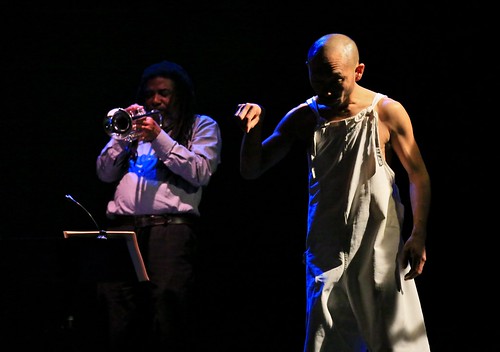
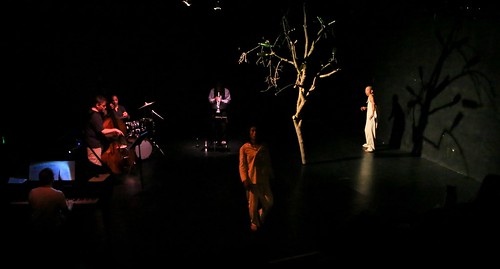
*Vietnamese Buddhist Greeting
 Alex Cline
[photo courtesy of Peak]
THE BEAST: When you were approached to perform at the Angel City Festival, was there a choice of recordings you wanted to pay tribute to?
ALEX CLINE: Nope.
People In Sorrow was the one thing I wanted to do. I did a set with my Band of the Moment at the [2009] Angel City Jazz Festival where we played a set that was basically all music from the seventies; we started with “Nan Madol” by Edward Vasala and then we did “Virtually” by the Soft Machine and finished with Joe Zawinul’s “Second Sunday In August.” In a way, that was part of wanting to share and interpret as repertoire some of the music that was really influential to me at a particular time when there was so much great music happening and such deep misery in my personal life…After that, I kind of re-excavated this idea of trying to do
People In Sorrow because after having the experience at the second Angel City concert and having it work, it seemed like a valid idea. I had spent years mulling this over as something that was either really worth doing or a complete waste of time.
Maybe a little bit of both…
Well, honestly, who wants to remake a masterpiece? People do it all the time. I think it has to be deeply personalized to work, and my goal for this concert is to be referential enough so as to pay the original its due respect while still diverting enough so that it becomes something new and different...I discussed the idea with a few musician friends of mine and got some feedback based on their own experiences. The only two people I did that with other than [my brother] Nels are two of the people playing, [trumpeter]
Dan Clucas and
Vinny Golia. Dan in particular was very enthusiastic, which was good because he was the only person I could imagine playing that brass role and he understands that milieu intimately and thoroughly. The other thing I realized in talking to musicians – or in Vinny’s case, his stories of sharing music with his [CalArts] students – was that an amazing and somewhat egregious number of people are completely unaware of this piece. I thought that I'd like people to go find it and listen to it because I think it’s an important and deeply moving piece of music...[It] had such a deep impact on my own composing that I felt like I did with that set at Angel City: If people had never heard it and just walked in and heard this they might think it’s not that different from my own music, because there is such a direct link conceptually…Now, the only thing that continued to be a niggling concern was that why would a West L.A. white guy want to resurrect a piece that was conceived during this incredibly tumultuous time in American history? I mean, there’s a racial component to all this and deservedly so. So why would anyone want to hear
my take on that?
A performance from last year's festival with many
of the same players of the People In Sorrow ensemble
A salient question.
Yeah. I still have concerns about that. But there are a few things that have come into play since that have made me feel a little less self-conscious about it. Amazingly, when I pitched this to the Angel City guys they came back to me and said, “What if we were to get
Roscoe Mitchell on the bill?’ I said, “Uhhh, that would be nice!”
[laughter] That was the beginning of an amazing series of smooth confluences. [Angel City co-organizer]
Jeff Gauthier’s wife
Maggie Parkins, who’s playing the concert, was involved with commissioning Roscoe to write a piece for the group she’s in –
the Eclipse String Quartet. They were going up to Oakland and perform it. Anyway, one thing led to another and somehow when Jeff was up there he arranged a lunch meeting with Roscoe, who teaches up at Mill College and lives in the Bay Area now. I actually wrote a letter to him explaining what I was doing with this piece why, and basically wanted him to react to that.
Must have been quite a letter to write.
It was. One of the things that was somewhat compelling...was that
People In Sorrow was to me an example of how music can deeply transform a person. That time of my life was so unhappy and confused, and the music I was listening to really indicated to me that there was something more to life, something meaningful and significant, which was not the way I was viewing things. I was utterly convinced that everything was meaningless and it was ultimately the music and a lot of the inspiration behind it saved my life. So I told him that in so many words…that I wanted to honor that piece, him, the Art Ensemble and the AACM together with a whole movement of music that showed me that there was something beyond what I had grown up thinking life was all about.
Roscoe Mitchell
How did that lunch meeting go?
Well, it turned out he was very cool about it, very nice, very friendly and very open to the idea and therefore indicated his blessing. Jeff asked him if he'd be interested in playing the same concert and if I’m correct he said something like, “Well, if the date works and the conditions are agreeable, yeah sure!” Literally within three days the idea for this concert existed – because he agreed to do it.
So how did you proceed to line up the musicians?
The thing that was really amazing was that virtually all of the musicians I contacted were not only available but totally into the idea. So were the people I was nervous about even asking, like
Oliver Lake. I sent him this email laying out my idea and my intentions, and he sent me back -- Oliver sends these very minimalist, very cogent emails – ‘great idea, great piece, love to do it.’
[laughter] So I was ecstatic.
I thought your choice of Mr. Lake was interesting, considering he and Julius Hemphill founded the Black Artists’ Group in St. Louis along similar lines as the AACM. Lake even initially proposed that they should be a branch of it. When did you first play with him?
I first played with him when I was 20 years old. It was January 1, 1976.
New Year’s Day?
Yep, he was in town visiting relatives, and we had a friend named Lee Kaplan who for whatever reason seemed to know everybody and what they were doing and was this great catalyst in the scene here back then. He somehow knew Oliver was in town and wasn’t doing anything and had his horn with him. Lee invited him to come over to my folk’s house and play with me. Then Nels got roped in to it and Lee sat in on synthesizer. I was twenty years old and I was playing with Oliver Lake! I was totally into
Heavy Spirits, which had just come out. My folks always made entertaining comments about all the people who came though the house: dancers, musicians of different stripes, eccentrics. It was quite a parade! But my parents remember Oliver showing up and how on guard he seemed, not comfortable, very circumspect and sort of checking everything out. But it was incredibly impressive to me that he was willing do do that. And playing with him was just an unbelievable experience. A year later, I was playing with Julius Hemphill. At that age, things progress very rapidly.
Why would you be nervous asking Lake to play on this project? I mean, if both you and your brother have played with the guy…
Well yeah, but he’s flying out from New York to play this set of music. So we have to make sure that everything else is in line so that this would not appear to be for any reason a waste of people’s time and energy. So it’s been an amazing journey for me and the festival, because they’re kind of putting their whole thing on the line for this concert. Technically speaking, even if they sell out every seat, [REDCAT] still isn’t big enough of a hall to cover the costs for the concert.
Yeah that was actually my next question. The AC organizers just concluded a successful Kickstarter campaign to raise funds to get all of the musicians out here for this show. It reminded me of something I recently read about Lester Bowie selling all of his furniture back in ’68 to fund the AACM’s relocation to France. I struck me, ‘Wow, so the infrastructure for this music is still shaky and still needs to be improvised from scratch.’ But now there’s the web and social networking. Has this made it at all easier or even harder to get the word out than it was when you first started your career?
I don’t think it’s easier or harder, just different. Part of the problem is that every time you have esoteric music you have an uphill struggle and it’s always going to be that way. It’s easier to get the word out now assuming it doesn’t get lost in the sheer mass of messages sent and received. It’s certainly helpful. One thing that’s dramatically different is you can pretty easily find out what’s going on at any given night in the city now…When Nels and I really started to get into this stuff we were totally unaware of almost anything that was going on on the other side of town – or the other side of any town for that matter. There really wasn’t any way to find out unless you knew where to look, and if you did you already knew what was happening. Certainly there is more appreciation for what was going on then then when it was actually going on; historically speaking people have caught up to what was going on in the city. But it’s still hard. You have all these shifting generations coming and you have the phenomena of learning to play jazz in college, which is really different from what it was when I was college-age, but still have very little in terms of involvement or interest in jazz in the more -- dare I say it -- "avant-garde" quadrants. I’m not a big champion of the avant-garde. I’m not doctrinaire about it. It’s not the only thing I care about. When Nels and I were listening to this music we were listening to a lot of other music that wasn’t as challenging. But for us, it was all the same, just different expressions of something deeper for us and that took many of different forms. We haven’t really changed much, or really changed at all, in that respect. In fact, we’ve gotten more open and broad in our acceptance and tolerance. The thing that is really challenging is dealing with people who can’t get past the notions that people have about the so called avant-garde: That it's inherently difficult, impenetrable, irritating, inaccessible, indulgent, whatever…that’s just so annoying, so frustrating, especially when people remain really stuck in those narrow points of view.
There’s definitely something about getting older that entrenches one in certain positions.
I guess so, and that’s where I’m going with this. These younger generations are people who should be absolutely wide open, and I don’t see a lot of young people who even want to play music along these lines. So what happens? Our generation of players, we’re getting older, and for a lot of us that means out lives are very different from when we were first doing this. That’s certainly true in my case. I can rarely go out to hear music anymore. I still play gigs, but I have to expertly craft how to do that with the least amount of negative impact on my family situation. I’m not the best example of someone who’s remained the relentlessly active and dedicated performer because like many of my peers life intervenes. So has it gotten easier or harder? Don’t know. It’s different. Our lives are, for sure. Those years when Vinny would practically be living at our parents’ house and we’d spend every waking minute in our guest room playing music, listening to music, talking about music, or John Carter calling on the phone and saying “Whaddya doin’ right now?” and driving up from his teaching gig in his Porsche to play with us. Nowadays I know I can’t do that anymore.

Vinny Golia (left) and Alex Cline onstage, 1980
[Photo courtesy of Mark Weber]
That’s why I really enjoy meeting the younger musicians now who are into this music, because they’re young enough that they have all this time to listen and play and absorb, and thankfully they listen to what some of us older guys have to recommend in terms of what they might have missed…This goes back to the reason to do this piece now, because it seems it passed a lot of people by the first or second time around. A lot of people don’t want to hear a piece that is so subtle and demanding and sustains this deep emotional intensity and meditative feeling. When people think of the Art Ensemble, they think of their more high-energy compositions and these flamboyant representations but that obviously is a very one dimensional view.
Have you ever met any of them?
I have never met Roscoe Mitchell before, but I was very lucky to have met and played with
Joseph Jarman.
Ever see them live?
Oh yeah. What’s interesting is that back then so many of those guys in their various projects actually were able to tour their own country. They’d came though L.A. and gave concerts and that’s how I was able to see them. I'll have to think about when and where.
[Alex later adds in an email:
I saw the Art Ensemble at UCLA’s Schoenberg Hall in what was probably 1979. John Carter and Bobby Bradford opened as a duo. The previous night Anthony Braxton played solo – on Tim Berne’s horn; Tim was in town to do some gigs, and Anthony’s horn got bashed in transit – and the Vinny Golia Trio with Roberto Miranda and yours truly opened for him…[They] also played in L.A. once at an upstairs space called the Studio, later called Studio Z, on Slauson Avenue, I can’t remember what year. I missed it because I was out of town playing, probably with Julius. Alex also recommends his favorite AACM recordings:
Other than the obvious People in Sorrow would be Fanfare for the Warriors, Phase One, Chi-Congo, Bap-Tizm and Nice Guys.
That’s obviously barely even a drop in the proverbial bucket. Related albums I feel I should mention which are from the members’ earlier AACM days are Roscoe Mitchell’s Sound, Joseph Jarman’s Song For and As If It Were the Seasons (a particular favorite of mine), and Lester Bowie’s Numbers 1 & 2.
These all reveal a lot about what was happening in Chicago during the late sixties and why the development of the AACM and its artists remains important and inspirational.]
The original People In Sorrow
had only four players; your reinterpretation has an ensemble of eleven. How did you select the musicians?
I knew it was going to be a bigger ensemble simply because of the way I was hearing it in my head. The orchestration I knew was going to include sounds that were not than the original. I also knew that sounds that I really liked on the original I wouldn’t be able to reproduce – like the
celeste, most people don’t have a celeste. So I spent a lot of time thinking about the kinds of sounds that I wanted and then of course the people I wanted to play them were to be not only in debt to this music but who also were seasoned improvisers whom I’ve worked with before. So Oliver, of course, was a no-brainer. Then Vinny, obviously because of our history together and because he was so affected by the music of the AACM and consequently has all these bazillions of woodwind instruments. I wanted Dan Clucas not only because he understands the music but in his own personal way can reference Lester Bowie's playing successfully without sounding like someone trying to imitate it. I have to confess that I am partial to strings, and so having Jeff Gauthier on violin and Maggie Parkins on cello was another no-brainer. [Bassist]
Mark Dresser is flawless, he can do everything, so that was easy. Obviously there are no chordal instruments on the original although they did play some keyboards and mallet instruments on it; I decided early on I didn’t just want a mallet to recall those glockenspiel-marimba moments in the record. I knew I wanted
Myra Melford because she’s from Chicago and is heavily influenced by the AACM, plus she has the harmonium thing that will come handy. In lieu of instruments like the celeste, I brought in
Zeena Parkins on harp – not the wacky electric harp she plays but acoustic. And that leaves
G.E. Stinson as the one player dealing with the most electronics.
G.E. was in Shadowfax, they were from Chicago as well, right?
G.E. was originally from Oklahoma, but he spent his coming-of-age years in Chicago, so a lot of the history of the AACM has a real intensity and immediacy for him. In a way he’s the wild card because instead of playing actual musical parts he’s the “free agent” as it were…There are certain things that he’ll have to do, but most of the time he’ll be responding to what going on.
Alex Cline, circa 1980
[Photo courtesy of Mark Weber]
You’ve also added a lot of voice accompaniment, from poets and a Buddhist chant to Mr. Dwight Trible.
I’ve aways loved voice, like strings I have a thing for it. I had been looking for a reason to work with Dwight for years. I always like what he does in a more “free” setting and he doesn’t do it very much. There’s this moment early on in the original People In Sorrow where someone hums the theme quietly, and it’s a very arresting moment when it happens. I thought we needed someone who could create this, so Dwight’s the man, right?…The Buddhist chant is something I wanted to incorporate as part of the extra-musical material that is informing this for me. I invited
Sister Dang Nghiem to do it and since she’s a monastic, I knew she wouldn’t be able to be here physically and I knew was a very strange request…We arranged to have it recorded by my friend Phil Stein, who told me, “You’ve gotta have her on video!" So this was recorded and filmed at Deer Park monastery down in Escondido in their Ocean of Peace meditation hall at 6:30 am. When I asked "Sister D," as everyone calls her, I explained the background of the piece and indicated that I wanted her to select something that she thought would be appropriate. She wound up choosing something called “Verses for Contemplation” and in Vietnamese and it’s really amazing and very intense. This connection stems not only from the fact that Sister D is a nun in a spiritual tradition that I practice, but that the time
People I Sorrow was recorded in 1969 was the time of the two significant world events that most affected me – civil rights and the Vietnam War. In a sense, because of things like racism and war, I see
People In Sorrow as being about suffering, how to face suffering, how to learn to not be afraid of it and ultimately transform it. Music like this helped me transform my own suffering. And transforming suffering is what Buddhism is all about. That’s the whole point of it.
MO PHAT FROM SISTER D
For People In Sorrow: An Homage by Alex Cline will unfurl itself at the REDCAT Theater on Sunday, Oct, 2 at 7pm. The Roscoe Mitchell Trio will play the second half of this concert at 8:30PM.