Showing posts with label Wadada Leo Smith. Show all posts

Wednesday, March 6, 2013

Under The Bottle Tree


Wadada Leo Smith & Oguri
[photos courtesy of Moses Hacmon]
 
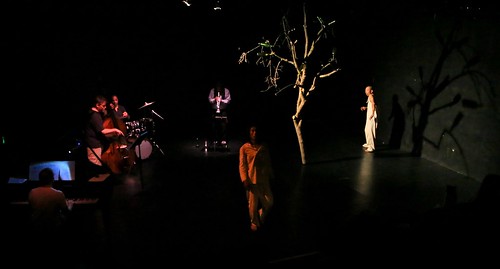
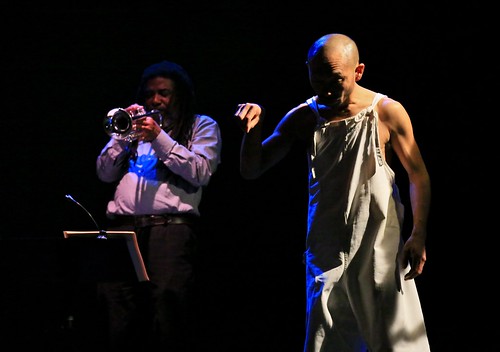
A Japanese butoh master and a free-jazz trumpeter seem like an incongruous fit, but the dark and turgid "freedom music" of trumpeter Wadada Leo Smith and Oguri's strenuous dances of confusion and deliverance both tackle fundamental human emotions in unapologetically abstract terms. Their latest collaboration NOTAWAY: Quest For Freedom, a loose reimagining of the river journey taken by Mark Twain's Huck Finn and escaped slave Jim -- part of a three-night stand at Venice's groovy-crunchy Electric Lodge last weekend -- brought this to an almost exhausting level.

Save for a slow prelude where they crouched in the dark like snipers in the weeds, the dancers – who included Oguri and fellow Body Weather artist Yasunari Tamai -- were in almost constant exertion underneath a large facsimile of a Southern "bottle tree" for the two-hour performance. Butoh is an intense and often confrontational dance style that emerged from a Japan devastated by WWII. It is as grueling to perform as it is to watch: A series of slo-mo friezes, angular stretches and mannequin-like poses. (Call it "extreme voguing.") By the end, both men's white tunics were darkened with sweat; the two of them alone must have driven the heat index in the space up to steam-bath levels.


Smith, dressed in a rumpled cream-colored suit, brought his Golden Quartet -- pianist Anthony Davis, bassist John Lindberg, drummer Pheeroan akLaff -- for an equally strenuous four-part suite that accompanied the dancers. There wasn't rhythm or pulse to latch onto. Smith kept the drums and bass under tight wraps to provide a tinge of unrelieved tension save for Lindberg skittering his bow up his strings, creating the sound of tiny electrical surges. The only source of melody came in starts and stops from Smith and Davis -- mirroring Huck and Jim's journey between servitude and freedom – which was anchored by Smith's distress-siren, a piercing sound in the small theater. A couple of Zen moments saw the band stopping entirely while the only sounds were the clicking floorboards under the dancers' feet.

Perhaps juiced by the physicality on display, Smith, who usually wanders on the edges of his own bands, directed his quartet with great sweeps and chops of his hand, occasionally yelling out "Hyahhhh!" and even wandering over to sit on Davis' piano bench while both men interplayed. At the end, Oguri and Tamai wandered back into the dark, arm in arm, as the last touch of the cymbal seemed to linger for a Buddhist moment. Meaning, forever. 


Speaking of Buddhism, percussionist Alex Cline's restaging of Roscoe Mitchell's classic AACM composition "People In Sorrow" at the 2011 Angel City Jazz Festival is now up on YouTube in its entirety. Definitely worth watching, especially for the chant towards the end from Buddhist monk  Sister Dang Nghiem. Check out our 2-part, pre-concert interview with Mr. Cline here. No bottle trees were involved.

Monday, May 23, 2011

LIVE REVIEW: Wadada Leo Smith & Motoko Honda Square Off in Someone's Living Room (5/22/11)

"The piano and I will be very surprised!" - Mimi Melnick

“I’m supposed to say something about music,” a soft-spoken Wadada Leo Smith told the crowd gathered in a sun-stippled Encino living room that overlooked an orange crate-art panorama of the West Valley. “It’s always hard to begin, so I’ll just start anywhere.”

The dreadlocked trumpet mystic-slash-music professor and his one-time Cal Arts pupil Motoko Honda (who have already blown people away performing together at the Barnsdall Gallery Theater and the old Rocco space) proceeded to make good on their promise: they started on that precipiece called “anywhere” and wound up “somewhere” quite different with two sets that consisted of at least five improvisational journeys that ranged from stretched out to surprisingly brief. It wasn’t an old-school jazz battle like “The Chase” but a mutual benediction of two minds twisting themselves around each other like two snakes on a caduceus staff. It was a bracingly eloquent fight club between Pupil and Teacher.

Piano, pimped

The Pupil had brought something new to the 1922 Steinway grand sitting in the corner by the patio doors. This piano has seen the fingers of Horace Tapscott, Gerald Wiggins and Nate Morgan to name just a short list, yet the Pupil brought the 21st century in from the cold and tricked out the instrument with a collection of electronic gizmos and wires including a KAOSS pad perched right above the action frame. Mistress of ceremonies Mimi Melnick (it was her house), as well as some of the whiter-haired old schoolers in the tiny audience, didn't know quite what to make of it. If one expected the Pupil to perform some sort of sleight-of-jazz with her techno frippery, she went the opposite direction. The Pupil barely used the devices -- and when she did, salt-and-peppering the roiling music she and the Teacher produced with admirable restraint. "We have a long history together," the Teacher smiled at the crowd.
 

Word. The Teacher began with splats of quavering half-notes; the Pupil sidling up to his runs with shimmering notes zipping like tiny little sprites dancing on the stalk of plants, traipsing up to the petals, then flying off and fading away. For the second improv, the Teacher muttered to the Pupil: "You start." She did, plinking the piano wires while hitting ominous clusters on the keys. The Teacher hung back as the Pupil went into a lyrical Bill Evans mode -- maybe with a little of Keith Jarrett's searching quality -- before unleashing an avalance of descending/ascending notes.

Next up was Smith's 2009 collaboration "Rabia's Unconditional Love: A Spiritual Mystery of the Heart," with the Pupil taking over the role of bassist Jack DeJohnette. The Teacher pushed ugly, flatulent sounds with his trumpet mute -- call it "playing while drowning" -- while the Pupil weighed in with her aggressive left hand, splitting jagged chords that leaked into a quiet twilight sleep. The Teacher ended the song with a strangle, playing bent over with the bell of the horn pointed straight into the carpet. They go even further on the closer "Joy: Spiritual Fire: Joy" from 2009's Spiritual Dimensions, with the Teacher finishing up with an outtake of breath that sounded like bubble wrap scraping across concrete. "By the way," the Teacher told us. "I know all of you."

Leo addresses the crowd

From Left: pianist Ben Rosenboom, bassist Mike Watt (yellow jacket),
and historian Steve Isoardi watch the show

At the end of the performance, Horace Tapscott's biographer turned to the Beast and remarked: "She reminds me of Horace."

Friday, February 18, 2011

Four Days in Febbo

The Beast hates Westwood. Hate hate hate hate. Hate so thick and creamy it could pass as Fosselman's ice cream. So of course where does Seattle's Experience Music Project decide to hold its 10th Annual Pop Music Conference (and first outside of Seattle)? Why, UCLA, of course! A lovely campus with many desirable resources to be sure -- but also a labrynthine mess of expensive (and paltry) parking and a confusing layout of buildings and side streets. In other words: UCLA is micro-Westwood within macro-Westwood -- the equivalent of a smaller-scale replica of Las Vegas within Las Vegas itself.
The subject of this year's conference (Feb. 25-27 -- that's next week, ffolkes!) is Cash Rules Everything Around Me: Music and Money, which makes one think that relocating to L.A. is a bit of an insult -- as if the organizers couldn't think of a better place to essay/assay the base and unrefined materialism of the music industry. So of course, our bitching must mean there's some pretty good panels available over the three days, right? RIGHT. You want names? How about Simon Reynolds, Oliver Wang, R.J. Smith, Greil Marcus, Eric Weisbard, Ann Powers, Robert Cristgau, Dan Charnas, Johnathan Lethem, Holly George-Warren, Cheetah Chrome, Seymour Stein as panelists. All of spread out evenly over all three days, which unfortunately means driving from the San Gabriel Valley all three days, which equates to about 4 1/2 hours of drive time plus about $40 in parking fees. Sigh.

Among the panels that interested us: "Scenes, Screens, and Schemes: The Multifarious Politics of Pop in Los Angeles" (ahh, there's that L.A. bashing), something enigmatically dubbed "Death's Kingdoms," "SoCal Polyphony", "Panic in the City: Episodes from a History of Suburban Revolt," "The Cost of Free Jazz" (with panelists Charles Sharp, Jeff Schwartz, Jeff Kaiser and Vinny Golia) and "Southland Sounds: Understanding Los Angeles Through Music." The titles of some of the original papers are even more tantalizing and frequently hilarious. To whit: "Go-Go Dancer and One-Hit Wonder: Toni Basil as Embodiment of Cultural Mobility in 60s Los Angeles"; "Forget It, Seymour Stein – It's the Chinatown Punk Wars"; "Hair, Hunger and Hollywood: Hear N' Aid and the Story of How Los Angeles Almost Saved Ethiopia," "The Jonas Brothers Are Dorky and Miley Cyrus Is a Slut: Gender, Power, and Money in the Disney Ghetto," "Animals, Cannibals, and Blah, Blah, Blah: Ke$ha and her Native Style"; "King of Bling: Liberace's Gilded Age" -- and those are just on the first day!

P.S. Across town, a day before the UCLA extravaganza (Thur., Feb. 24) , USC will host a one-day mini-conference entitled Work It: Gender, Race, and Sexuality in Pop Professions, with an equally great lineup of speakers: Ann Powers, Daphne Carr, Marissa Meltzer, Daphne A. Brooks, Nikki Darling, Gayle Wald, Margaret Wappler. This is also free and open to the public.

P.P.S. Yes yes yes it is all fine and good to listen to people talk about music, but if one is starving for a little nonverbal conversation, mystical trumpeter-teacher-shaman Wadada Leo Smith will perform with members of the Southwest Chamber Music ensemble Sat. the 26th downntown at the Coburn School as part of the SCM's "The Voice of New Classical Music" season. Not a bad night to get in a break from the flying bon mots.

Thursday, October 7, 2010

ANGEL CITY JAZZ FESTIVAL 2010: The First Leg


Ahh opening night. The electric-shaver buzz in the air! The expectant crowds milling about! The familiar faces! The parking fees! Welcome to the Angel City Jazz Festival Year Three. And for some reason – maybe momentum, maybe a perverse urge towards a Viking-style funeral – this year's bill was the most radical one yet. After getting a toehold with the first two years, what the hell were festival organizers Jeff Gauthier and Rocco Somazzi thinking?

I would be the wrong person to ask that question. My urge towards the fringier fringes of Out There music is not a good indicator of my judgment of a festival roster’s bankability. The esteemed music critic Greg Burk (who also reviewed the festival) asked me Monday night over dinner what I thought of this year’s lineup of artists and I froze with mouthful of cured tuna hearts. “I think it’s great!” was all I could muster. Burk was coming at me from the Long View of things: in order for this music and for the only annual festival to celebrate it to survive, it needs to embrace both the Out and the In. (To whit: last year’s sandwiching of the relatively straight-ahead B3 organisms of Larry Goldings between guitar freek-a-leek Nels Cline and the prepared piano of Motoko Honda.) I was coming at it from the blissfully oblivious punk-rock stance of, “the more extreme the better!” Which is why I don’t run a record label. I like Viking funerals.

This year, the extreme was exhibited in the majority of acts over the first few days having absolutely no set list. There were exceptions -- Kneebody and Ravi Coltrane on Sunday and the Trible/Beasley duo on Saturday – but the main feature was inventing a journey for the ears that wasn’t always “fun” in the classic sense. Like a good novel the music contained all emotions, from anxiety to abandon, from confusion to rapture. Hell, there was boredom in there a few times too, and the task of both performers and audience alike to wrest free of it.

Saturday was the much-ballyhooed return to L.A. of Mr. Henry Grimes, the bassist who has become as celebrated for the Hollywood-worthy tale of his rediscovery and rehabilitation as his pioneering work with the godheads of free jazz (Ayler, Taylor, Shepp, Sanders, Coltrane, Coleman). In fact, Grimes’ “story” has been told twice and Social Network-style in two opposing accounts in the last two months: first by scholar Steven Isoardi (“The Return of Henry Grimes: A Memoir” -- emphasis on that last word) and then a month later in the new literary quarterly Slake by journalist Hank Cherry (“The Resurrection of Henry Grimes”). It's a story, underscored by Mr. Gauthier’s opening remarks, that encompasses “hope, creativity and not giving up in the face of dire circumstances” and “very much an L.A. story.” We won’t get into all that here – in fact, we shudder at the thought of Grimes' story making to the big screen and becoming another The Soloist, complete with Kanye West or Sean Combs bobbing for Oscar cred by playing the troubled bassist. Suffice to say, all the crackling anticipation in the REDCAT theatre precluded that Mr. Grimes would be received rapturously if he simply stood onstage and did nothing but scratch his ear. He did stand onstage, but nothing the man did was simple.

Mr. Grimes’ set was preceded by the duo of vocalist Dwight Trible and pianist John Beasley, who took their own sweet time setting a subtle, churchified mood for their short set. They began with an improvised duet and moving into more structured material like “Autumn Leaves” and a bracing medley of “The Spirit of Love” with the more dire standard “Strange Fruit,” with Trible creating cubistic psalms over Beasley’s soft tide pools and mathematical chimes. They even paid tribute to current economic woes (which, as indie jazz musicians, they must feel quite acutely) with the closer, “Backlash Blues.” Four bars in, someone yelled from the audience: “I like it already!!”

Henry Grimes, with Olive Oil

The auditorium was dead quiet when Grimey & Co. shuffled out of the wings like gunfighting pilgrims. Grimes, dressed in baggy black pants, rumpled Hawaiian shirt and canary-yellow headband (his rotating headgear is like the jazz world’s version of the Bears' Jim McMahon), bent over the green-painted bass named “Olive Oil” (a gift from N.Y. loft vet William Parker) and started his knotty boxer’s hands dancing over the strings. This was the first of at least three improvisations that ranged from hellacious cacophony to near-silent meditation. The drama was heightened by the musicians (with minimal rehearsal and minimal direction) struggling across the tightrope together. It was 15 minutes before any kind of noticeable rhythm started and in that time Grimes switched from arco to pizzicato and then over to violin, while pianist Ben Rosenboom switched from the keyboard to the inner strings of the piano, Vinny Golia switched from baritone sax to clarinet to bass clarinet, Alex Cline switched from wire brushes to mallets to whatever else he had up his sleeve, and poor Dwight Trible (a last minute addition) switched from standing up to sitting down, as it appeared he was having difficulty fitting his vocals into the cracks of the ensemble’s intensity. But for intensity, one needed to look no further than the MVP of the evening Alex Cline, who towards the end of the set shattered the almost-quaint egalitarianism of the band by launching into a chest-rumbling and heavily caffeinated tribal beat that drew the rest of the players – even the maestro himself, who appeared not to once notice he had any bandmates – into its let’s-go-out-on-a-high-note sway.

Nels tears the Ford a new one
(photo courtesy of Myles Regan)

If Saturday night was the feather tickling, Sunday evening at the Ford Amphitheatre was the motherlode of weirdness, the anti-Hollywood Bowl. The bicoastal quintet Kneebody played like a bunch of young punks who just came from a show at The Smell. Vinny Golia returned for some funkified cold fusion with a youthful ensemble culled from his CalArts students. (Did we actually catch Golia dancing a little onstage?!). Nels Cline practically stomped a hole in the stage floor as he and saxist Tim Berne and three-armed drummer Jim Black went for the apocalyptic orgasm in an entirely improvised set that included Berne’s siren-like wails that he muted by sticking an empty Arrowhead water bottle into the bell of his horn.
Wadada
(photo courtesy of Myles Regan)

Wadada Leo Smith, who also backed Mr. Grimes on Saturday and who likes to stand at the edge of his bands like a character in the margins of an old MAD magazine, led his Golden Quartet in a groove-tinged set with some powerful players, including hot keyboardist Vijay Iyer (whose own current Solos CD is getting rapturous buzz) and the bewitching John Lindberg, who ran his bass through a pedal and created an otherworldly and elongated sound I can only regrettably call “bowelly.” (This made the L.A. Times jazz critic Chris Barton laugh -- although thank god he didn't mention it in his review of the show.) With their serpentine interplay and clean, well-lighted songs, the quintet led by saxophonist Ravi Coltrane (second son of John and Alice) and trumpeter Ralph Alessi tucked us into bed and kissed us on the cheek.

Ravi Coltrane/Ralph Alessi Quartet
(photo courtesy of Myles Regan)

The next night at Culver City's Royal/T Cafe was more of a cozy, family affair that mixed musical improvisation with multimedia flash and culinary wizardry courtesy of visiting chefs Paul Canales and Kelsey Bergstrom. (Indeed, Carol Kim's live video feeds of musicians and kitchen staff heightened the similarities between food and music—and further proved to me that chefs are the new DJs.) There was a metal tub packed with ice and stacked with bottles of Rahsaan Roland Kirk Dark Lager. There were silver multi-storied dishes of farmer’s market green beans and grissini dip. There were tablecloths, for god’s sake. All accompanied by the strangest dinner music we’ve ever heard, a true ebbing-and-flowing blast of West Coast airs anchored by the leadership of bassist Mark Dresser and pianist Myra Melford, who played a white mini-grand besmirched with subway graffiti, and brought to the brink by the butoh dance master Oguri, who squeezed himself between the banquet tables like that Tooms guy from The X Files. The Brothers Cline took a brief duo interlude during Dresser's "Rasa" that made one marvel at the talented womb they both were sprung from—and how ageless both seem when they are playing together. (Nels' recent collaborator and bride-to-be Yuka Honda was almost invisible behind Melford's piano, hunched over a tiny keyboard-sized piece of electronics called a Tenori-on.) The second set veered almost shockingly into verboten blues territory, with violinist Jeff Gauthier and Mark Dresser chasing each other in mad-stringed brotherhood. (I’m not sure of this, but some loud female voice kept yelling out “Mark Dresser! Yeah! Play it! Wooo!” during his solo, and I swear to God it might have been Ms. Melford, whom I’ve heard utter few words in person.) At the end of this wonderful evening, both Rocco and Jeff were spent but smiling. What do they know that we don’t?

Drawing by Deborah Drooz on my notebook
while I was in the Men's Room at the Royal/T
Check out the Ford performances on YouTube's Angel City Jazz TV page.